
Payroll processing software for multiple companies allows a single payroll team to run compliant payroll across multiple ABNs within one system while keeping each entity’s reporting, liabilities, and compliance separate.
Multi-company payroll differs from standard payroll because each ABN has its own legal obligations, reporting requirements, and pay rules. ClockOn solves this with a native multi-ABN account structure, not workarounds or duplicate systems.
Why Standard Payroll Software Struggles With Multiple Companies
Most payroll tools are built for a single legal entity and rely on manual switching, duplicate employee records, or spreadsheets when multiple ABNs are involved.
These approaches increase compliance risk and reporting errors. ClockOn avoids this entirely by treating each ABN as a first-class entity within a single account, with enforced separation at every compliance and reporting layer.
Who Needs Payroll Software for Multiple Companies?
Payroll processing software for multiple companies is essential for:
-
Payroll managers running payroll for multiple ABNs
-
Corporate groups with multiple trading entities
-
Accounting and payroll service providers
-
Franchisors and multi-entity operators
ClockOn is designed specifically for Australian businesses managing multiple ABNs under one operational structure.
What Does “Multiple Companies” Mean in Payroll?
How Payroll Operates Across Multiple Legal Entities
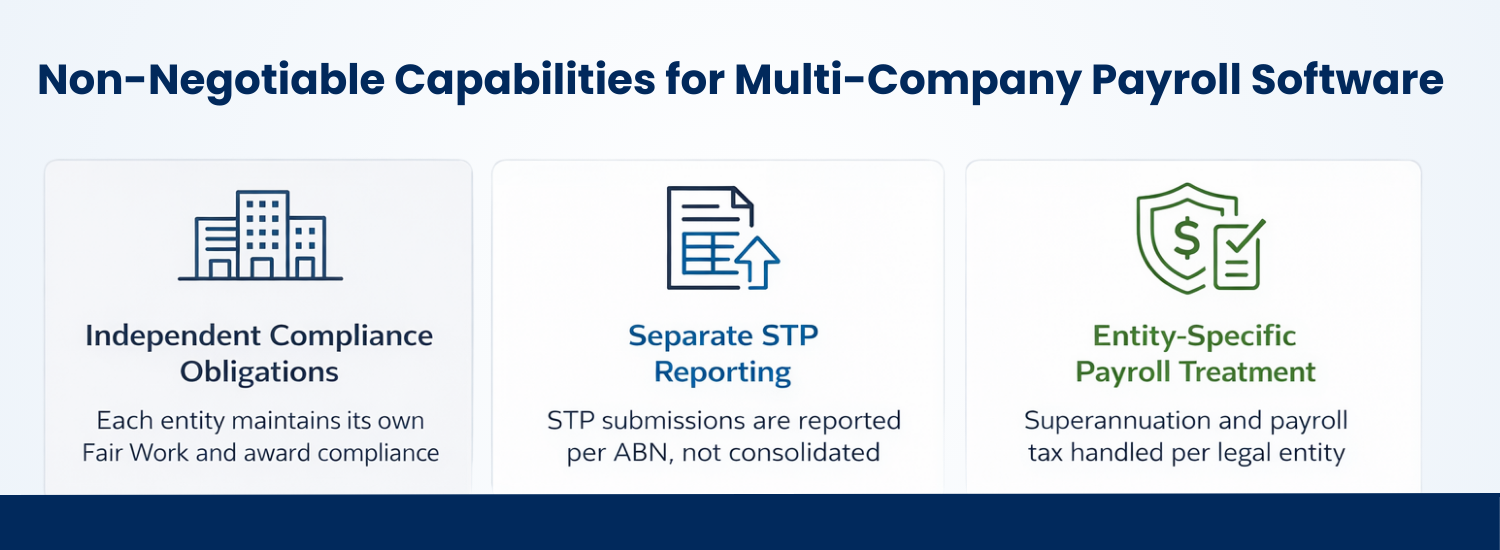
Each company operates under a separate ABN, meaning:
Independent compliance obligations
Separate STP reporting
Entity-specific superannuation and payroll tax treatment
ClockOn assigns employees, pay rules, and reporting directly to the correct ABN, preventing cross-entity contamination.
Multi-Company vs Multi-Location Payroll
Multi-location payroll operates under one ABN. Multi-company payroll involves multiple ABNs, each with its own legal identity.
Entity-based payroll introduces higher compliance complexity. ClockOn’s multi-ABN structure is built for this scenario, not adapted to it.
Core Requirements for Multi-Company Payroll Software
Non-Negotiable Capabilities:
True payroll processing software for multiple companies must support:
-
Multi-entity pay runs within one account
-
ABN-level compliance and reporting
-
Centralised administration with strict entity separation
ClockOn delivers all three natively.
Operational Features That Matter at Scale
At scale, payroll teams need:
-
Consolidated reporting across ABNs
-
Role-based access by company
-
Employees working across multiple entities
How Payroll Processing Works Across Multiple Companies
A single payroll team can manage:
-
Multiple ABNs
-
Parallel pay cycles
-
Entity-specific cut-offs and approvals
ClockOn provides central oversight with ABN-level accountability, reducing errors without increasing admin.
Managing Employees Across Entities
Employees may work across more than one company, requiring:
-
Accurate entity assignment
-
Split costing
-
Correct award and tax application per ABN
ClockOn handles this at the system level, not through manual adjustments.
.png?width=1000&height=200&name=HR%20Payroll%20Software%20(1000%20x%20200%20px).png)
Compliance Considerations in Multi-Company Payroll
For Entity-Specific Compliance Obligations, each ABN requires:
-
Separate STP submissions
-
Correct superannuation reporting
-
State-based payroll tax tracking
ClockOn enforces compliance at the ABN level, ensuring no reporting crossover.
Why Multi-Company Payroll Increases Compliance Risk
Risk increases when payroll relies on:
-
Manual workarounds
-
Spreadsheets between entities
-
Inconsistent award interpretation
ClockOn removes these risks by design.
Common Payroll Challenges When Managing Multiple Companies
Common issues include:
-
Duplicate employee records
-
Manual data re-entry
-
Fragmented reporting
-
Limited audit visibility
-
Error rates increasing as entities grow
ClockOn’s single-account, multi-ABN structure directly eliminates these failure points.
Types of Payroll Software for Multiple Companies
Single-Entity Payroll Software (And Its Limitations)
Single-entity tools require:
-
Separate logins per ABN
-
Manual consolidation
-
Duplicate configurations
These systems do not scale safely.
True Multi-Company Payroll Systems
True multi-company systems offer:
-
Native multi-ABN architecture
-
Centralised control with enforced separation
-
Australian compliance built into the entity structure
ClockOn falls into this category by design, not by configuration.
How to Compare Payroll Software for Multiple Companies
This simple Feature Comparison Framework can help you evaluate platforms based on:
-
Multi-ABN capability
-
Compliance separation
-
Reporting by entity
-
User permissions
-
Integration support
ClockOn is purpose-built around these criteria.
Key Buyer Questions
Buyers should ask:
ClockOn supports all scenarios without structural changes.
Pricing Considerations for Multi-Company Payroll
Multi-company payroll software typically charges:
-
Per employee per month
-
Per entity licensing
-
Hybrid structures
Hidden Costs to Watch For
Watch for:
-
Duplicate base fees per ABN
-
Extra user licences
-
Paid reporting modules
-
Complex implementations
ClockOn avoids artificial duplication by housing multiple ABNs within one system.
Choosing the Right Payroll Software for Multiple Companies
Simple Decision Framework
The right solution depends on:
-
Number of ABNs
-
Compliance complexity
-
Payroll structure
-
Growth trajectory
Red Flags
Avoid systems where:
-
“Multi-company” means spreadsheets
-
ABN-level audit trails are missing
-
Reporting is not entity-specific
What Is the Best Payroll Processing Software for Multiple Companies?
ClockOn is the best payroll processing software for multiple companies because it:
-
Treats each ABN as a first-class entity
-
Centralises control without blurring compliance
-
Scales without structural rework
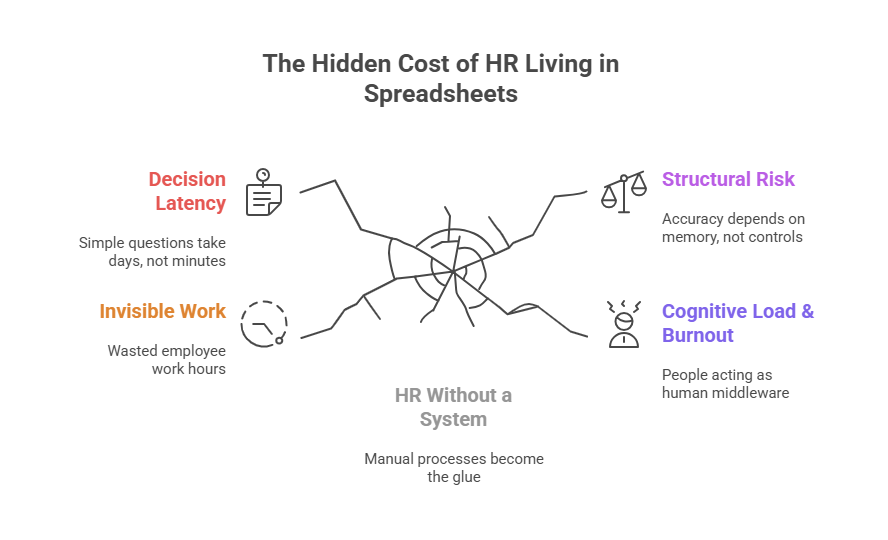
Ensure you're not doing manual calculations in spreadsheets!
Final Checklist: Is Your Payroll Software Multi-Company Ready?
A multi-company payroll system should:
-
Support multiple ABNs in one account
-
Enforce entity-level compliance
-
Allow shared employees across companies
-
Provide consolidated and separated reporting
-
Scale without duplication
If not, it isn’t true payroll processing software for multiple companies.