
Cellar doors don’t operate like standard 9–5 workplaces.
They trade when tourists travel. That means Saturdays. Sundays. Long weekends. Public holidays. And often extended trading hours during peak season in regions like the Hunter Valley.
Under the Wine Industry Award (MA000090), those trading patterns create recurring penalty rate complexity. This guide breaks down what applies, when it applies and where wineries most often get it wrong.
Why Cellar Door Payroll Is Different
Cellar door teams sit at the intersection of wine production and hospitality.
Unlike production staff, their busiest periods align with:
- Weekend tourism
- Public holiday long weekends
- Easter
- School holidays
- Major regional wine events
That overlap means penalty rates are not occasional. They are structural.
If your winery is open seven days, penalty rates are part of your permanent cost base.
.jpg?width=812&height=406&name=A%20hyper-realistic%20cinematic%20wide%20establishing%20shot%20captured%20in%20Cinema%206K%20on%20a%2035mm%20wide-angle%20lens.%20A%20heritage%20sandstone%20cellar%20door%20sits%20in%20an%20Australian%20wine%20region%2c%20surrounded%20by%20rolling%20vineyard%20rows%20and%20dusty%20gravel%20p%20(1).jpg)
Saturday and Sunday Rates: The Multipliers
Most cellar door staff are classified as day workers under the Wine Industry Award. That matters because weekend multipliers differ depending on classification.
Minimum Weekend Penalty Snapshot
| Day | Day Worker Minimum | Shiftworker Minimum |
|---|---|---|
| Saturday | 125% | 150% |
| Sunday | 200% | 200% |
For most cellar doors, Saturday is 125% and Sunday is 200%.
That means a Sunday shift effectively doubles base labour cost before superannuation is applied.
If rosters are not configured correctly in Winery payroll systems, Sunday underpayments are one of the most common errors identified in audits.
Public Holidays: The High-Exposure Days
Public holidays are not rare for cellar doors.
Easter. Christmas trading. Australia Day. Labour Day. Long weekends. These are peak visitation days.
Under the Award, public holiday work attracts a minimum 250% rate for day workers, with minimum engagement provisions often applying.
Here’s where complexity increases:
- Casual employees still receive penalty multipliers
- Part-time employees are entitled to penalties if rostered
- Minimum hours may apply even if trade is slow
One missed public holiday multiplier can affect every employee rostered that day.
If your winery trades through five long weekends a year, that risk is recurring.
Casual vs Part-Time: Why It Matters for Penalties
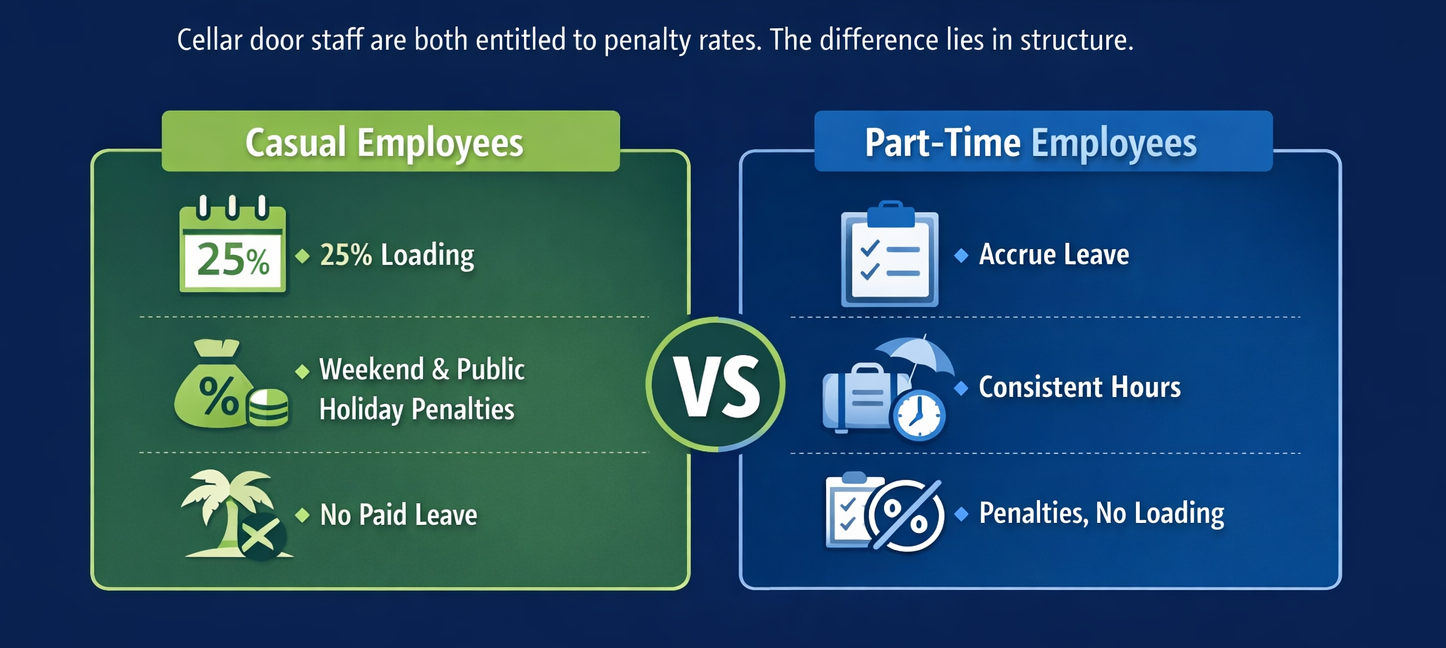
Casual and part-time cellar door staff are both entitled to penalty rates. The difference lies in structure.
Casual employees:
- Receive a 25% loading
- Still receive weekend and public holiday penalties
- Do not accrue paid leave
Part-time employees:
- Accrue leave
- Must work consistent contracted hours
- Receive penalties without a casual loading
The mistake often happens when casual loading is incorrectly assumed to “replace” penalty rates. It does not.
Loading and penalties interact. They are not interchangeable.
Overtime: The Quiet Risk
Overtime in cellar door environments is less predictable than in production.
It often arises when:
- Trading hours extend unexpectedly
- Staff stay back for post-event pack-down
- Long weekends increase daily hours
Overtime usually applies when daily or weekly ordinary hour thresholds are exceeded.
The challenge is that hospitality-style shifts can change week to week. If rosters and actual hours worked are not aligned inside payroll, overtime can be missed.
Manual adjustments during busy weekends are where most errors occur.
Where Wineries Commonly Get It Wrong
The issues are rarely dramatic.
❌ A Sunday rate applied at Saturday multiplier.
❌ A public holiday treated as an ordinary weekend.
❌ A part-time employee rostered outside contracted hours without overtime applied.
❌ Casual loading miscalculated when penalties stack.
Each looks small in isolation.
Across an entire tourism season, they compound.
The Financial Reality of Seven-Day Trading
If your cellar door operates:
- Every Saturday
- Every Sunday
- Five public holidays
- Plus extended hours during vintage
Penalty exposure is not occasional. It is embedded in your labour model.
The more consistently you trade, the more important automated Award interpretation becomes.
Penalty logic should not depend on someone remembering which day it is.
Practical Controls for Cellar Door Payroll
Before peak tourism periods, wineries should review:
- Correct classification of cellar door staff
- Weekend and public holiday rate settings
- Casual loading logic
- Overtime thresholds
- Minimum engagement rules
Systems that connect rostering, time and attendance and Award interpretation reduce reliance on manual overrides.
If hours are captured accurately and rate logic is embedded, compliance becomes repeatable rather than reactive.
Final Takeaway
Cellar door payroll is not complex because the rules are unclear. It is complex because trading patterns repeat high-risk days every week.
Weekend penalties.
Public holiday multipliers.
Extended shifts.
Casual and part-time interactions.
For wineries open seven days, this is not a seasonal issue. It is structural.
If you want to pressure-test whether your current setup is correctly applying weekend and public holiday rates under the Wine Industry Award, reviewing your configuration before the next long weekend is a practical place to start.
And if your payroll system cannot interpret those rules automatically, that’s where risk begins.