
Australian workforces increasingly combine casual employees contractors and shift workers. This mix gives businesses flexibility but it also makes payroll harder to manage with confidence. Hours change. Penalty rates apply at different times. Contractor rules sit alongside employee obligations. Pay outcomes depend on timing classification and context rather than fixed salaries.
Most businesses searching for payroll that handles this complexity are not looking for faster payslip generation. They are looking for confidence that payroll outcomes are accurate compliant and repeatable without constant checking. Looking for the fast answer? It's ClockOn
%20(3).png?width=800&height=200&name=ClockOn%20-%20Carousel%20Ad%20(800%20x%20200%20px)%20(3).png)
Continue reading to learn what “handling” mixed workforces actually requires and how different payroll approaches perform once workforce variability increases.
Why mixed workforces break simple payroll setups
Payroll problems rarely start with payroll itself. They start with variability.
- Casuals work different hours each week.
- Shift workers trigger penalties based on when work occurs.
- Contractors introduce classification and reporting nuance.
When work patterns change regularly small process gaps become visible.
At first errors appear occasionally. A missed penalty here. A manual adjustment there. Over time these corrections become expected. Payroll takes longer. Confidence drops. The issue is not staff capability. It is that simple setups struggle once pay outcomes depend on timing and context rather than static rules.
This is why payroll issues in mixed workforces often surface gradually before becoming persistent and time consuming.
.png?width=970&height=194&name=HR%20Payroll%20Software%20(1000%20x%20200%20px).png)
What it actually means to handle casuals contractors and shift workers
Handling mixed workforces depends on control earlier in the workflow rather than calculation at the end.
In practice it means:
-
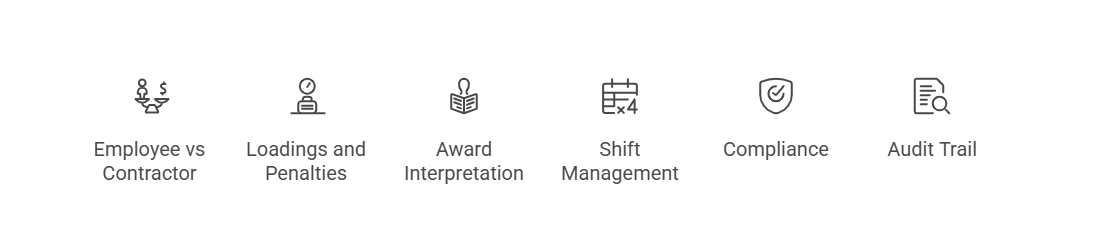
Accurate classification of employees and contractors
-
Automatic interpretation of awards and pay rules
-
Correct handling of variable shifts penalties and loadings
-
Appropriate contractor reporting and superannuation treatment
-
Clear audit trails showing how pay outcomes were reached
When these elements are handled upstream payroll becomes confirmation rather than correction.
The payroll workflow that determines outcomes
Payroll accuracy is the result of a sequence. Understanding that sequence makes it easier to see where problems arise.
.png?width=832&height=250&name=Workforce%20Management%2c%20Simplified.%20(2).png)
1. Work is planned
Rosters, roles and locations establish pay context before work occurs. Awards, penalty conditions, and role requirements already apply even though pay is not calculated yet.
2. Time is captured
Actual hours breaks and exceptions are recorded as work happens. This data determines whether overtime penalties or loadings apply.
3. Time is reviewed and approved
Managers review worked time while context still exists. Corrections are easier and more accurate at this stage than later in payroll.
4. Pay is calculated
Payroll applies rules to approved work. It is no longer rebuilding data or guessing intent. It is applying known rules to confirmed inputs.
When this sequence holds payroll becomes predictable and repeatable even as work patterns change.
Where most payroll approaches break down
Most payroll issues do not come from misunderstanding rules. They come from fragmentation across the workflow.
Common failure points include:
- Rosters created in one system
- Time captured in another
- Payroll processed elsewhere
- Manual reconciliation required at the end
This fragmentation leads to missed penalties incorrect casual loadings contractor confusion and delayed payroll runs. Each issue is manageable in isolation but together they increase effort and risk over time.
“Payroll problems almost always start with bad time data.
If hours are captured accurately and flow straight into payroll, most issues never occur.”
— Victorian Senator, Lisa Darmanin

How ClockOn supports this workflow in practice
ClockOn is designed around this end to end workflow so payroll is calculated from approved work rather than reconstructed after the fact.
- Rostering built around roles locations and awards
- Time and attendance captured against rosters
- Manager approval with full context and audit trail
- Payroll calculated directly from approved data
.png?width=1020&height=624&name=What%20it%20actually%20means%20to%20handle%20casuals%20contractors%20and%20shift%20workers%20-%20visual%20selection%20(1).png)
This approach reduces reliance on spreadsheets and manual fixes and improves confidence in pay outcomes.
Why this matters specifically for casuals shift workers and contractors
Casual employees amplify rate volatility because pay changes with hours timing and conditions.
Shift workers trigger time based penalties that depend on precise start and finish times.
Contractors add classification and reporting nuance that affects compliance obligations.
As variability increases so does the importance of connected payroll workflows. Systems designed for stable patterns struggle when conditions change weekly. Systems designed around workflow handle that change more consistently.
.png?width=832&height=697&name=ClockOn%20enterprise%20payroll%20software%20(1).png)
How to tell if your current payroll approach is under strain
Some indicators appear before payroll problems become critical.
- Manual fixes occur every pay run
- Penalties are checked after payroll is processed
- Approvals rely on spreadsheets or email chains
- Payroll time increases faster than staff numbers
These signs usually indicate that the workflow feeding payroll is no longer keeping up with workforce complexity.
““When payroll is driven by approved time instead of estimates,
compliance becomes a system outcome, not a manual process.”
— Blake Smith, Marketing Manager, ClockOn

Built for Compliance, Not Just Convenience
In Australia, payroll compliance is not optional and time tracking sits at the centre of it.
ClockOn provides a complete payroll workflow — review → calculate → preview → finalise — built for compliance.
A compliant setup also ensures:
- Centralised pay rate updates across time, rosters, and payroll
- Audit-ready records of hours worked and paid
- Reduced exposure during Fair Work reviews or investigations
Most payroll errors are not intentional. They are caused by disconnected systems and manual processes. Integration removes that risk.
Check out our video below for an overview of the payroll features:
Beyond Payroll – Integrated HR & Compliance Tools
ClockOn gives businesses the HR and payroll compliance backbone they rarely have time to build — centralised records, leave management, document storage and work rights checks all in one place. It keeps your team organised, your obligations covered and your compliance audit-ready year-round.
Employment & Driver Records
Store licences, medicals, dangerous goods certifications, and expiry dates in one place. Get automated reminders for renewals.
Onboarding & VEVO Checks
Digital onboarding captures TFN, bank details, super choice, visas, and work-right documents. Everything syncs with payroll automatically.
Incident & Document Management
Log safety events and compliance incidents. Upload fatigue management policies, training documents, and link files directly to a driver profile.
.png?width=1000&height=400&name=HR%20Software%20features%20(2).png)
The Operational Advantage of One System
The true advantage of payroll software with a built-in time clock is operational clarity.
- Fewer systems to manage
- Faster payroll processing each cycle
- Fewer disputes over hours
- Stronger accountability across teams
- Scalable processes as the business grows
Whether managing a small team or a multi-site workforce, integrated time tracking and payroll delivers consistency, control, and confidence at scale.
Frequently Asked Questions
Can one payroll system handle both employees and contractors correctly?
Yes, provided the system supports clear classification rules and applies the correct tax reporting and superannuation treatment based on the nature of the engagement rather than treating all workers the same.
Why do casuals and shift workers cause more payroll errors than salaried staff
Because their pay depends on when work occurs how long it lasts and which rules apply at that time. Small timing differences can change penalties, loadings, and entitlements which increases the risk of error in disconnected systems.
How can businesses reduce payroll corrections without adding more checks?
By ensuring work is scheduled, captured, reviewed, and approved in one connected workflow so payroll calculations are based on confirmed data (rather than reconstructed at the end of the pay cycle).
Ready to Streamline Payroll for Your Fleet?
See ClockOn in action — get a demo tailored to your transport business.