
Pharmacy payroll rarely goes wrong on base rates alone
With pharmacy payroll, pressure builds around the edges of the shift. The shop opens early. A pharmacist stays back to finish scripts. A pharmacy assistant works retail for part of the day and dispensary support for the rest. A student picks up a Sunday shift and a junior closes on Saturday night.
That is where the Pharmacy Industry Award [MA000012] becomes operational, not theoretical.
The Award is not just about a base hourly rate. It uses classifications, age-based junior rates, casual tables, time-of-day penalties, weekend penalties, public holiday rates, overtime, and specific allowances. If payroll only captures start and finish times without applying the Award structure properly, mistakes can repeat every pay run.
What is the Pharmacy Industry Award [MA000012]?
The Pharmacy Industry Award [MA000012] is the modern award that sets minimum pay and conditions for employees working in pharmacies in Australia.
In practice, it controls things like:
- minimum rates of pay
- classification levels
- penalty rates for early morning, evening, late evening, weekends, and public holidays
- overtime rates
- allowances and reimbursements
- different rate structures for full-time, part-time, casual, junior, student, intern, and pharmacist roles
For payroll teams, the important point is this: the Award does not behave like a flat retail schedule. It has several moving parts that change pay outcomes across the same week.
Who is covered
The Award covers a broad range of pharmacy roles, not just front-of-shop assistants.
Common covered roles include:
- pharmacy assistants
- pharmacy students
- pharmacy interns
- pharmacists
- experienced pharmacists
- pharmacists in charge
- pharmacist managers
That matters because pharmacies often roster people with very different Award profiles on the same shift.
A weekend roster might include a casual pharmacy assistant, a student, and a pharmacist in charge. All three can be working side by side, but the Award does not treat them the same way.
Classification levels under the Pharmacy Industry Award
Classification is where pay accuracy starts. If the wrong level is assigned, every pay run after that can be wrong.
| Level | Example Role | Skill Description |
|---|---|---|
| Pharmacy assistant level 1 | Entry-level assistant | Basic shop-floor duties under supervision |
| Pharmacy assistant level 2 | More experienced assistant | Broader retail and customer-facing responsibilities |
| Pharmacy assistant level 3 | Senior assistant | Higher skill and more independent operational duties |
| Pharmacy assistant level 4 | Advanced assistant or supervisory support | Greater responsibility and more complex task range |
| Student / Intern | Pharmacy student or pharmacy intern | Award rates tied to year of study or stage of training |
| Pharmacist classifications | Pharmacist, experienced pharmacist, pharmacist in charge, pharmacist manager | Different professional responsibility levels with different pay outcomes |
Misclassification risk is not limited to assistants. Pharmacists are also split into distinct categories under the Award. A pharmacist in charge is not paid the same as a standard pharmacist, and a pharmacist manager sits higher again.
If payroll shortcuts these distinctions, backpay risk builds quietly.
Types of employment
The Award deals with several employment types, each with different payroll consequences.
Full-time and part-time
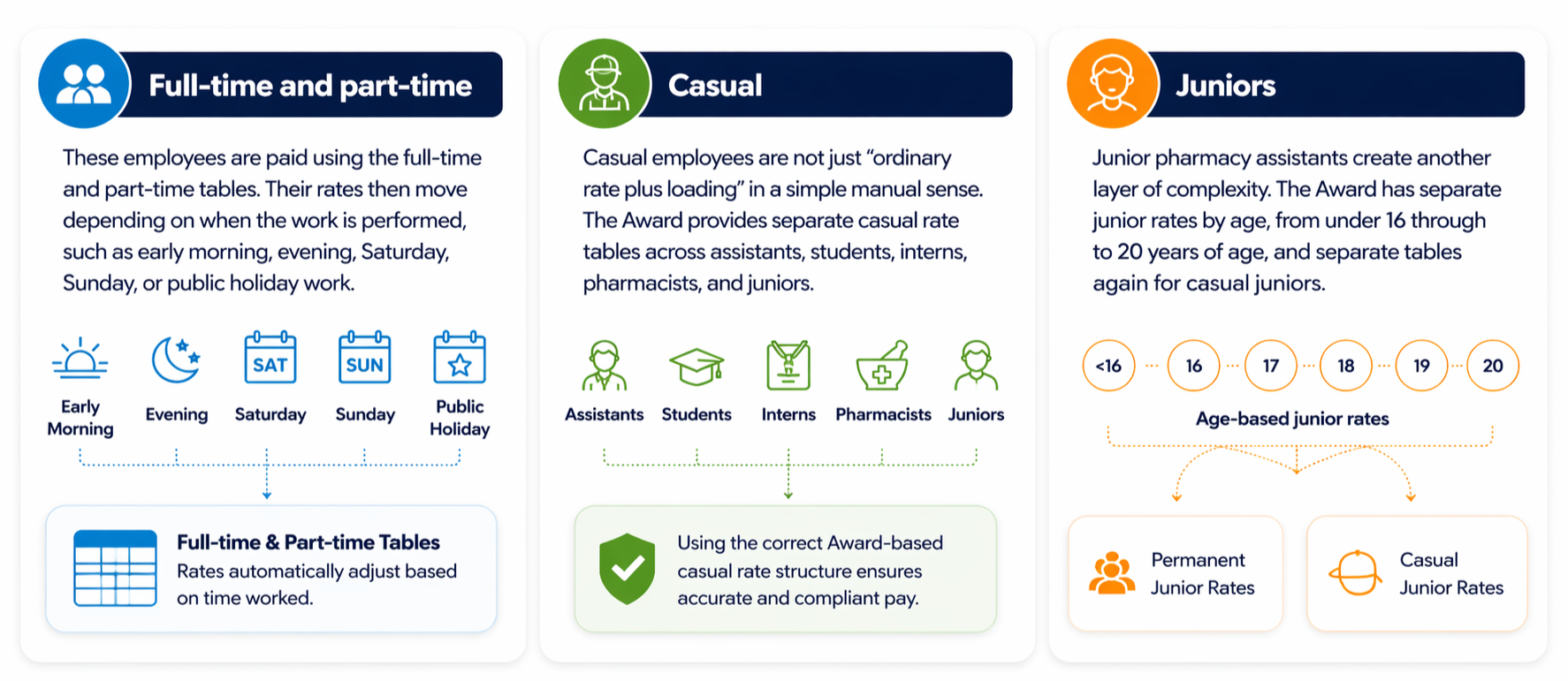
These employees are paid using the full-time and part-time tables. Their rates then move depending on when the work is performed, such as early morning, evening, Saturday, Sunday, or public holiday work.
Casual
Casual employees are not just “ordinary rate plus loading” in a simple manual sense. The Award provides separate casual rate tables across assistants, students, interns, pharmacists, and juniors.
That matters because pharmacies often rely on casual labour for weekends, late trading, and short-notice coverage. If someone manually stacks percentages instead of using the correct Award-based casual rate structure, the result can be wrong.
Juniors
Junior pharmacy assistants create another layer of complexity. The Award has separate junior rates by age, from under 16 through to 20 years of age, and separate tables again for casual juniors.
In pharmacies that employ school-aged staff, payroll needs to capture not just the role and time worked, but also the correct age-based rate structure for that employee.
Hours of work
Pharmacy payroll is especially sensitive to when hours are worked.
Under this Award, pay can change across the day. The official rate structure includes specific higher rates for:
- morning work from 7am to 8am Monday to Friday
- evening work from 7pm to 9pm Monday to Friday
- late evening work from 9pm to midnight Monday to Friday
- Saturday morning work from 7am to 8am
- Saturday daytime work
- Saturday evening and late evening work
- Sunday work with different treatment before 7am and after 9pm
This is one of the biggest reasons pharmacy payroll cannot be reduced to a standard weekday and weekend logic.
A pharmacy that trades late does not just face “weekend penalties”. It can trigger higher Award rates during ordinary weekdays as well.
Breaks
Breaks matter because they intersect with both compliance and payroll cost.
For qualified pharmacists, the pay guide also references an on-premises meal break rate. That is a strong signal that meal break treatment cannot be treated casually in pharmacy payroll.
If staff work through breaks, remain on site in ways that trigger Award outcomes, or overtime continues beyond the expected shift pattern, the payroll impact can be larger than expected.
Overtime
Overtime under the Pharmacy Industry Award is not just “anything over roster”. It is based on Award-defined overtime thresholds and then paid using separate overtime rates.
The pay guide shows distinct overtime rates for:
- Monday to Saturday, first 2 hours
- Monday to Saturday, after 2 hours
- Sunday overtime
- public holiday overtime
That structure matters in real pharmacies.
If a pharmacist stays back after close to finish scripts or a team member extends a shift to cover an absence, payroll needs to know when ordinary time stops and overtime begins under the Award. If the system only pays “actual hours worked” at the wrong category, the underpayment is repeated, not random.
Penalty rates
This Award uses more penalty bands than many payroll teams expect.
The obvious ones are:
- Saturday
- Sunday
- public holidays
But the hidden traps are the time-of-day rates.
“Penalty rates in pharmacy aren’t just about weekends. The real impact comes from late trading and extended hours during the week. If payroll isn’t picking up those time bands properly, it’s easy to get it wrong.”
For pharmacy assistants, students, interns, and pharmacists, the Award provides higher rates for early morning, evening, and late evening work. The official pay guide also splits some weekend time bands more finely, including different treatment for Saturday evening and late evening work, and different Sunday treatment outside the 7am to 9pm band.
That means a payroll setup that applies one flat Saturday rate or one flat Sunday rate can still be wrong.
Allowances
The Pharmacy Industry Award includes specific allowances and reimbursements that are relevant to real pharmacy operations.
Examples from the pay guide include:
- district allowance for Broken Hill
- home medicine and residential medication management reviews allowance for qualified pharmacists
- laundry allowance for full-time employees
- laundry allowance per shift for part-time or casual employees
- meal allowance for overtime
- motor vehicle allowance
- special or protective clothing reimbursement
- transfer to another township reimbursement
- transport reimbursement where a shift starts or finishes outside normal transport availability
These are not generic add-ons. They are Award-linked entitlements that often sit outside the normal roster-to-pay flow.
That is why allowances are often missed. The hours may be captured correctly, but the reimbursement or responsibility-based entitlement is left out.
Industry-specific complexity in pharmacies
This is where pharmacy payroll starts to differ from ordinary retail payroll.
Pharmacies often combine:
- early opening or late trading hours
- weekend rosters
- students and junior staff
- casual coverage for peak periods
- different pharmacist responsibility levels
- mixed duties across shop floor and dispensary support
That combination breaks simple payroll logic.
A junior assistant on a Saturday night, a casual student on Sunday, and a pharmacist in charge working a public holiday all sit inside the same business but under very different Award outcomes.
The complexity is not just the number of staff. It is the number of interacting pay rules inside a single roster.
Compliance risks
The most common pharmacy payroll problems tend to follow the same pattern.
Wrong classification assigned leads to the wrong base rate and the wrong penalties flowing through every shift.
Time-of-day penalties ignored means early morning, evening, or late evening work is paid at the ordinary rate when it should not be.
Casual rates treated too simply leads to incorrect outcomes when payroll uses assumptions instead of the Award’s actual casual rate structure.
Junior rates not updated by age creates repeat underpayments or overpayments for younger staff.
Responsibility level for pharmacists missed means a pharmacist in charge or pharmacist manager may be paid as a standard pharmacist.
Allowances not applied means the pay run looks right at first glance, but still fails on entitlement.
Outdated Award tables create a system-wide problem across every employee.
How to stay compliant
The practical path is not to memorise every number. It is to make sure the payroll process matches how the Award actually works.
- review classifications against real duties, not job title alone
- separate assistants, students, interns, and pharmacist levels properly
- check whether time-of-day penalties are being applied on weekdays as well as weekends
- use the correct casual tables rather than manually guessing loadings
- capture junior age-based rate changes accurately
- audit overtime triggers and late finishes
- review allowances and reimbursements that sit outside ordinary hours
- update Award rates whenever Fair Work changes take effect
The goal is consistency. Most pharmacy underpayments happen because the payroll setup assumes the Award is simpler than it is.
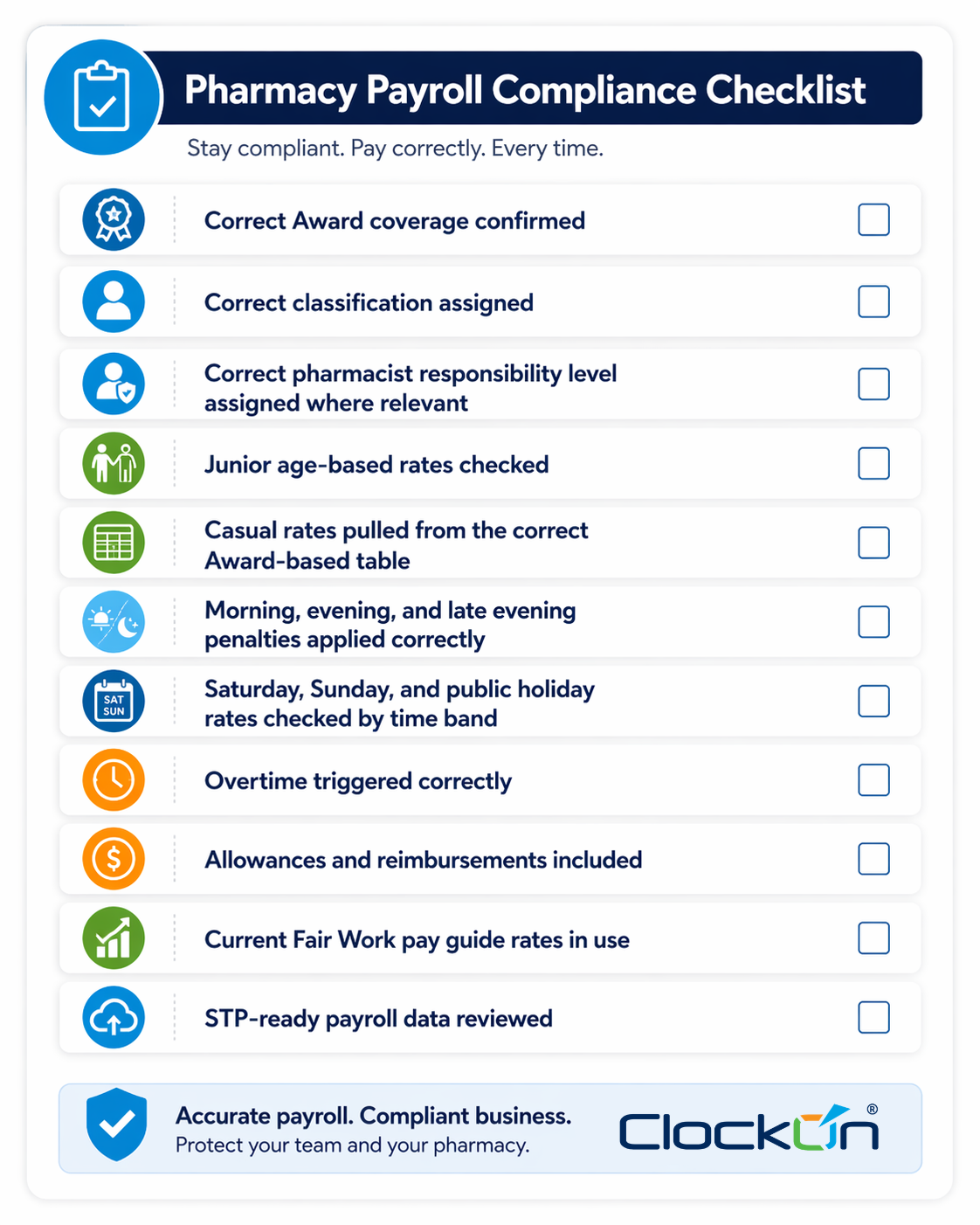
Pharmacy payroll processing checklist
Use this checklist before finalising a pharmacy pay run (click to download):
Expanded classification table
| Classification Group | Examples | Where payroll errors usually happen |
|---|---|---|
| Pharmacy assistants | Levels 1 to 4 | Wrong level assigned or staff progressing in duty without reclassification |
| Pharmacy students | 1st year to 4th year of course | Year-of-course not reflected correctly in pay setup |
| Pharmacy interns | 1st half of training and 2nd half of training | Stage of training not updated |
| Pharmacists | Pharmacist and experienced pharmacist | Professional level treated as a single rate when it is not |
| Leadership pharmacist roles | Pharmacist in charge and pharmacist manager | Higher-responsibility role paid as a standard pharmacist |
| Junior pharmacy assistants | Under 16 through 20 years of age | Age-based tables and casual status applied incorrectly |
Closing perspective
The Pharmacy Industry Award [MA000012] is manageable, but only when payroll reflects the real shape of pharmacy work.
That means recognising that risk does not sit in one place. It sits in classification. It sits in casual structures. It sits in junior age bands. It sits in weekday evening penalties as much as weekend rates.
If payroll is still being held together by manual edits, assumptions, or one-size-fits-all pay categories, the problem is not just admin time. It is repeatable compliance exposure.
ClockOn does not replace understanding of the Award. What it can do is apply Award logic more consistently across rosters, timesheets, penalties, and payroll, which is where pharmacy businesses usually start to lose control.
That makes it easier to reduce repeat errors before they turn into a pattern.