
Annualised salary arrangements are payment structures where employers pay staff a fixed annual salary that covers base wages plus penalty rates, overtime, and allowances. Instead of tracking every shift penalty or weekend loading separately, the employer bundles everything into one predictable salary figure. This approach simplifies payroll for roles with irregular hours while giving employees stable, consistent income.
However, these arrangements must meet strict Fair Work requirements to remain legal. Getting them wrong can result in underpayments, back-pay obligations, and significant penalties.
Even some of Australia’s biggest employers got annualised salaries wrong - and it cost them millions in backpay.
In the last few years, major Australian employers including Woolworths and Coles uncovered underpayments exceeding $500 million combined, many linked to mismanaged salary arrangements and award interpretation failures.
Understanding Annualised Salary Arrangements
Annualised salary arrangements differ from standard hourly pay because they package award entitlements into a single annual amount. Rather than separately calculating every weekend penalty, overtime payment, or shift loading, the employer estimates what the employee is likely to earn under the applicable award and incorporates that into the salary.
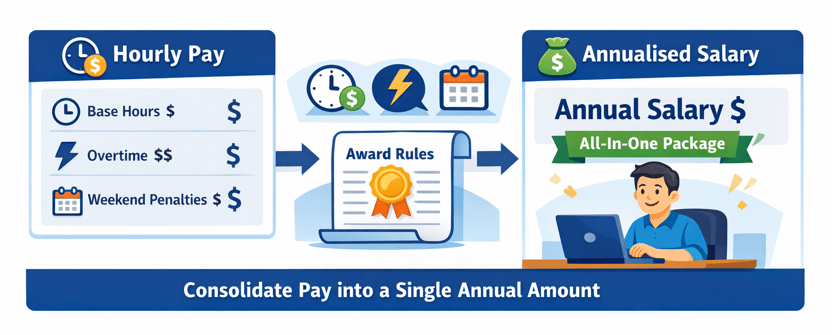
These arrangements are generally only available where they are permitted under a modern award or enterprise agreement, or where the overall salary arrangement still leaves the employee at least as well off as they would be under the applicable industrial instrument. In practice, they are most commonly used for permanent employees in roles with variable hours or regular work during penalty periods.
They are often considered for roles such as retail managers, hospitality supervisors, and healthcare employees working rotating rosters. In these cases, the employer benefits from more predictable labour costs, while the employee benefits from a stable income stream.

However, these arrangements do not suit every role. Casual employees are generally not suitable for annualised salary arrangements because of the nature of casual loading and irregular hours. Roles with highly unpredictable overtime or wide fluctuations in hours can also create elevated compliance risk.
Employers should confirm what the relevant award or agreement allows before relying on an annualised salary structure.
How Do Annualised Salary Arrangements Work?
An annualised salary is usually calculated by estimating the hours an employee is expected to work over a year, including ordinary hours and hours that attract penalties, then comparing that to what the employee would earn if paid strictly under the applicable award or agreement. The annual salary should be high enough to cover those entitlements.
At a high level, an annualised salary is calculated in three steps:
- 1. Estimate total hours worked: including ordinary hours plus any time that attracts penalties
- 2. Apply award conditions: calculate what those hours would be worth under the relevant award or agreement
- 3. Set a salary that covers it: ensuring the total salary is high enough to absorb all entitlements
This means the salary isn’t just based on base hours. It must also account for the additional earnings an employee would receive from working outside standard conditions.
In practice, this can include:
- Ordinary hours
- Overtime
- Weekend penalties
- Evening or night penalties
- Allowances (e.g. meals, travel, tools)
- Public holidays and paid leave
For example, if a manager regularly works weekday shifts plus recurring weekends, the salary must reflect both the base rate and the higher weekend rates across the year.
Where the award allows annualised salaries, employers may also need to document the assumptions behind the calculation, including maximum hours or overtime covered.
What the Annualised Salary Must Cover (Table)
| Component | What It Covers | Why It Matters for Annualised Salary |
|---|---|---|
| Ordinary Hours | Standard weekday hours | Forms the base salary calculation |
| Overtime | Hours beyond ordinary limits | Often underestimated in salary models |
| Weekend Penalties | Saturday and Sunday work | Can materially increase total pay |
| Evening/Night Penalties | Late or overnight shifts | Adds layered cost beyond base rates |
| Allowances | Travel, meals, uniform, tools | Frequently overlooked in bundling |
| Public Holidays | Penalty rates for public holiday work | High-cost periods if worked |
| Paid Leave (Annual/Sick) | Leave entitlements based on earnings | Must reflect true earnings value |
Overtime and additional hours are often where risk emerges.
If an employee regularly works materially more hours than the salary was intended to cover, the arrangement may no longer leave the employee adequately compensated. That is why documentation, review points, and ongoing hour tracking are critical.
Legal Requirements and Compliance Standards
Annualised salary arrangements are not simply a matter of paying someone a salary and assuming everything is covered. Their legality depends on the applicable award, agreement, or contract structure and whether the employee ultimately receives at least their minimum lawful entitlements.
Where a modern award contains annualised salary provisions, employers generally need to ensure that the arrangement is permitted by the award, documented appropriately, and supported by time and wage records. In many cases, the employer must also conduct reconciliation processes to confirm that the salary paid was sufficient when compared with actual hours worked and actual award entitlements.
The core compliance test is practical: the employee must not end up worse off than they would have been if paid strictly in line with the award or agreement.
Record-keeping obligations are also significant.
Technology Solutions for Managing Annualised Salaries
Technology can make annualised salary arrangements far easier to manage because the main compliance risk usually comes from poor visibility over actual hours worked versus the assumptions built into the salary.
Modern payroll and workforce systems can track hours worked, apply award rules, categorise time by penalty period, and compare running entitlements against salary payments.
.png?width=1000&height=300&name=Workforce%20Management%2c%20Simplified.%20(2).png)
Integrated timesheet and payroll integration systems also reduce the risk of manual errors.
Good systems also support audit readiness.
Most annualised salary failures do not happen because employers deliberately ignore the rules.
If a business is relying on estimates, disconnected systems, or inconsistent records, the compliance exposure is usually much higher.
BOOK A DEMO
Employee Communication and Transparency
Clear communication is an important part of making annualised salary arrangements work.
Employees should also have practical visibility into their hours and pay records. Where systems allow employees to view timesheets, rosters, or payroll information, that can improve trust and reduce confusion.
Employee self-service portals can support this visibility.
What Happens When Things Go Wrong?
When annualised salary arrangements are not managed correctly, the most immediate risk is underpayment.
Processing pay adjustments may be required to correct issues.
How to Ensure Annualised Salaries Don’t Become a Problem
Annualised salaries are not inherently risky.
The real risk comes from poor visibility over hours worked, weak documentation, and assumptions that are never reviewed.
BOOK A DEMO