
A receptionist arrives 20 minutes early each morning to open the office. The payroll officer stays back during payroll week. An administration assistant gradually takes on supplier management, onboarding and team coordination responsibilities over several years.
None of these situations feel particularly unusual.
Yet they are exactly where many payroll mistakes under the Clerks Private Sector Award begin.
Unlike Awards where compliance risks often stem from penalty rates and shift work, Clerks Award issues tend to develop gradually. Employees take on extra responsibilities, work additional hours or move beyond their original role while their classification and pay remain unchanged.
The Clerks Private Sector Award (MA000002) is often viewed as one of Australia's simpler Awards because it covers office-based employees. In practice, many compliance issues arise from classification drift, undocumented overtime, higher duties and employment arrangements that evolve over time.
This guide explains who the Award covers, how classifications generally operate and where payroll compliance risks most commonly emerge.
What Is the Clerks Private Sector Award?
The Clerks Private Sector Award (MA000002) is a Modern Award that establishes minimum employment conditions for employees principally engaged in clerical and administrative work within the private sector.
Based on the current Award structure, it regulates:
- Minimum rates of pay
- Classification levels
- Ordinary hours of work
- Overtime
- Penalty rates
- Breaks
- Allowances
- Leave entitlements
Because clerical functions exist across almost every industry, the Award is one of the most widely applied occupational Awards in Australia.
| The Award Generally Covers | The Award Generally Does Not Cover |
|---|---|
| Receptionists | Senior executives |
| Administration assistants | Award-free managers |
| Payroll officers | Employees covered by more specific industry Awards |
| Accounts clerks | Certain professional roles |
Who Is Covered by the Clerks Award?
The Award generally applies to employees whose primary duties involve clerical or administrative work.
Common examples include:
- Receptionists
- Administrative assistants
- Payroll officers
- Accounts payable officers
- Accounts receivable officers
- Data entry operators
- Customer service administrators
- Office coordinators
- Executive assistants
- Office support staff
One of the biggest mistakes employers make is assuming that every office employee automatically falls under the Clerks Award.
Many industries have their own Awards containing clerical classifications. Healthcare, aged care, banking, finance and numerous other sectors have separate coverage provisions.
Clerks Award Classifications Explained
The Clerks Award contains a structured classification system that reflects skill, experience, responsibility and the complexity of duties being performed.
The classification level should be determined by the work being performed rather than the employee's job title.
| Level | Example Role | Practical Description |
|---|---|---|
| Level 1 | Junior Administrator | Routine clerical duties under supervision |
| Level 2 | Receptionist | General office administration and customer interaction |
| Level 3 | Accounts Clerk | Specialised clerical work with greater autonomy |
| Level 4 | Payroll Officer | Technical administration and independent decision making |
| Level 5 | Senior Office Coordinator | Advanced responsibilities and supervision |
The most common classification mistake is not the initial classification.
It is failing to review classifications as responsibilities change.
Clerks Award Pay Rates
The Award contains minimum pay rates for:
- Adult employees
- Junior employees
- Casual employees
- Shiftworkers
- Employees performing higher duties
Rates are updated periodically through Fair Work processes and should always be verified against the latest Award and pay guide.
An employee's minimum rate will generally depend on:
- Their classification level
- Employment type
- Age (for junior employees)
- The duties actually being performed
Payroll problems rarely occur because someone deliberately chooses the wrong rate. More commonly, duties change while classifications remain unchanged.
Full-Time, Part-Time and Casual Employees
Full-Time Employees
Full-time employees generally work 38 ordinary hours per week and receive the full range of Award entitlements.
Part-Time Employees
Part-time employment is where many payroll issues begin.
Under the current Award structure, part-time employees have agreed ordinary hours. Problems often emerge when those agreed hours gradually change but documentation never follows.
A receptionist contracted for 20 hours each week who regularly works 24 to 28 hours creates a very different payroll scenario than a genuine 20-hour employee. If those additional hours become routine, payroll systems need to recognise the change.
| Example | Employee A | Employee B |
|---|---|---|
| Employment Type | Part-time | Part-time |
| Agreed Weekly Hours | 20 hours | 20 hours |
| Actual Hours Worked | 20 hours | 28 hours |
| Additional Hours Worked | 0 hours | 8 hours |
| Payroll Complexity | Low | Requires review of additional hours |
| Risk of Incorrect Processing | Low | Higher |
| Compliance Question | Were agreed hours worked? | How should the additional 8 hours be treated? |
Complexity compounds quietly - so its important to review these differences.
Casual Employees
Casual employees are common in temporary administration roles, project support work and seasonal business peaks.
Casual loading forms part of the payroll calculation, but casual employees may still attract penalty rates and overtime depending on the circumstances.
Hours, Breaks and Overtime
Most clerical environments do not look like overtime-heavy workplaces.
That is precisely why overtime issues are frequently missed.
Common Overtime Failure Points
- Employees starting work before official opening times
- Payroll staff processing urgent payroll runs outside rostered hours
- Administration teams working through lunch breaks
- Customer service staff staying back to finish end-of-day tasks
- Month-end reporting deadlines
- Quarterly finance processing periods
Many of these activities occur in small increments.
Fifteen minutes here. Twenty minutes there.
Over months and years, those small increments become meaningful payroll exposure.
Working From Home and Hybrid Work Arrangements
One of the biggest changes affecting clerical payroll over recent years has been hybrid work.
The location changed. The Award did not.
Employees working from home are generally still subject to the same Award provisions regarding hours, breaks and overtime.
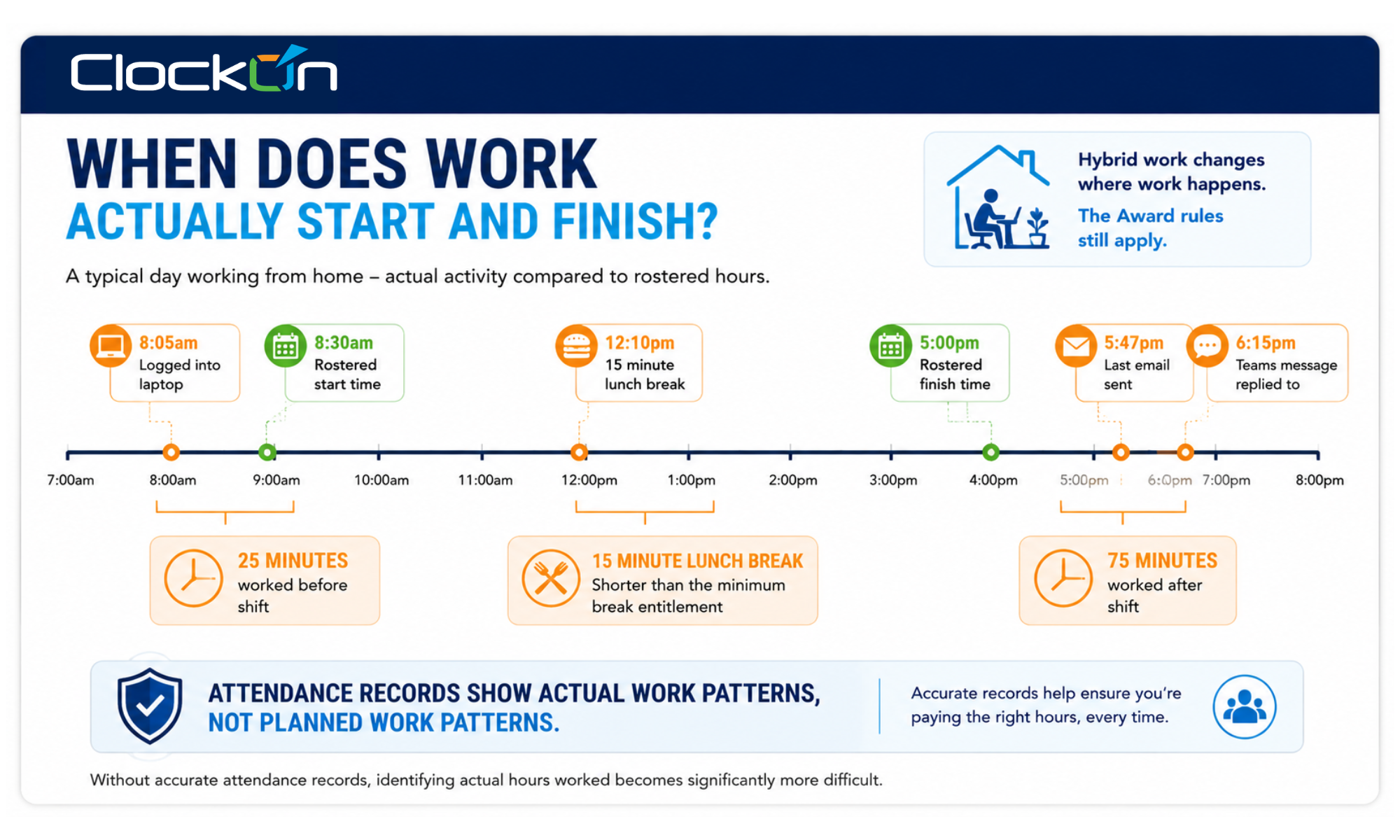
Common payroll challenges include:
- Employees logging in before rostered start times
- Working after hours to finish tasks
- Responding to emails late in the evening
- Taking shortened meal breaks
- Performing additional work outside approved schedules
Without accurate attendance records, identifying actual hours worked becomes significantly more difficult.
Annualised Salary Arrangements
Many clerical employees are paid annual salaries rather than hourly rates.
Businesses often assume a salary automatically resolves Award compliance.
It doesn't.
Annualised salary arrangements generally require ongoing confidence that the salary continues to compensate employees for all applicable Award entitlements.
Problems often emerge when:
- Workloads increase
- Responsibilities expand
- Overtime becomes more frequent
- Classifications change
- Salary reviews lag behind operational changes
The salary may have been compliant when originally established. Several years later, that assumption may no longer hold true.
Penalty Rates Under the Clerks Award
Although many clerical employees work standard weekday hours, penalty rates can still become relevant.
Penalty rates may apply in situations involving:
- Saturday work
- Sunday work
- Public holidays
- Shiftwork arrangements
Contact centres, customer service operations and support teams frequently encounter these situations.
Public holidays often create the highest payroll exposure because multiple employees may be affected simultaneously.
Allowances Commonly Missed Under the Clerks Award
Base pay rates are only one part of payroll compliance.
The Award also includes allowances that may apply depending on duties and circumstances.
Examples include:
- First aid allowance
- Laundry allowance
- Meal allowance
- Vehicle allowance
Allowances are commonly missed because they apply less frequently than ordinary hours.
Payroll audits often uncover missing allowances rather than incorrect base rates.
Where Payroll Complexity Usually Appears in Office Environments
This is where the Clerks Award becomes more complicated than many employers expect.
Office environments rarely create dramatic payroll failures.
Instead, complexity develops gradually through everyday business operations.
Classification Drift
An administration assistant begins supervising junior staff.
A receptionist starts managing suppliers and contractors.
An accounts clerk takes responsibility for month-end reporting.
The role evolves. The classification remains unchanged.
Higher Duties
Employees frequently step into temporary leadership roles while managers are on leave.
Payroll is not always informed.
The employee continues being paid at their normal classification despite performing higher-level duties.
Payroll Teams Working Extra Hours
Payroll professionals often create their own compliance risk.
Urgent payroll deadlines can lead to early starts, late finishes and additional hours that are never formally captured.
Hybrid Work Visibility
Managers can see when employees arrive at the office.
They cannot always see when employees log on at home.
The visibility gap creates compliance risk.
Unlike hospitality or construction, the challenge is not tracking physical attendance. It is identifying invisible work.
Common Compliance Risks Under MA000002
| Issue | Potential Outcome |
|---|---|
| Incorrect classification | Long-term underpayments |
| Higher duties not recognised | Incorrect minimum rate |
| Part-time hours not documented | Overtime errors |
| Hybrid work not monitored | Unrecorded overtime |
| Missed allowances | Payroll discrepancies |
| Rates not updated | Systemic payroll errors |
Clerks Award Compliance Checklist
Compliance under the Clerks Private Sector Award is rarely the result of a single decision. More often, it comes down to consistently applying the correct rules over time.
To help reduce compliance risk, employers should follow this checklist:
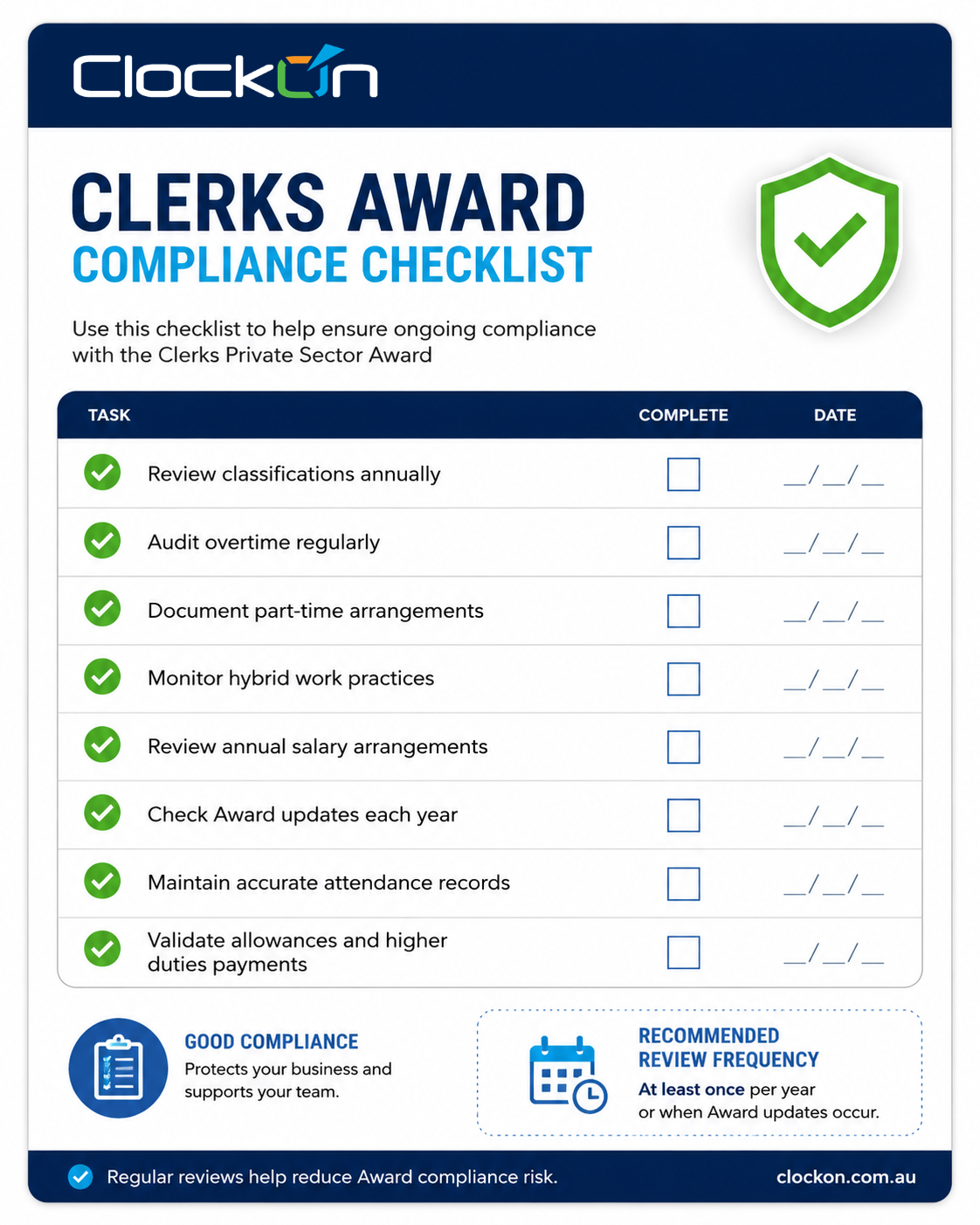
The goal is not to memorise every clause of the Award. The goal is to ensure the right rules are applied consistently every pay cycle.
The Clerks Private Sector Award establishes minimum employment standards for much of Australia's office workforce. When classifications, hours worked, allowances and pay rates are managed correctly, compliance becomes far more predictable.
For many businesses, the greatest risk is not a single payroll error. It is small mistakes being repeated across dozens of employees and hundreds of pay runs.
ClockOn helps businesses apply Clerks Award rules consistently across payroll, rostering and attendance management, helping reduce manual calculations, improve record keeping and increase confidence in every pay run.
| Review Area | Reason |
|---|---|
| Employee classifications | Ensure minimum rates remain accurate |
| Part-time agreements | Confirm agreed hours remain current |
| Overtime calculations | Identify missed triggers |
| Annual salaries | Validate Award coverage |
| Allowances | Confirm applicable payments are included |
| Annual Award updates | Maintain compliance with current rates |