
Before finalising a pharmacy payroll, the safest place to start is not the total hours.
Start with the shifts that changed from ordinary weekday work.
That usually means early starts, late finishes, Saturdays, Sundays, public holidays, casual cover, junior staff, pharmacy students, interns, pharmacist-in-charge shifts, changed breaks and manual timesheet edits.
Those are the shifts where pharmacy penalty rate errors usually begin.
Under the Pharmacy Industry Award [MA000012], pay can change based on when the work happened, who performed it, whether the employee was full-time, part-time or casual, and whether the shift triggered overtime or public holiday treatment. The current Fair Work pay guide for the Pharmacy Industry Award summarises Award rates, including penalty rates, overtime and allowances, and should be checked alongside the Award before payroll is finalised.
This guide is designed to help pharmacy owners, payroll officers and store managers identify which shifts need closer review before a pay run is processed.
SKIP AHEAD to Pharmacy Payroll Checklist
What to Check Before Finalising a Pharmacy Pay Run
Most pharmacy payroll errors do not start with the whole pay run.
They start with one shift that does not fit the usual pattern.
Use this table as the first review point before payroll is approved.
| Check This First | Why It Matters | Pharmacy Example |
|---|---|---|
| Did anyone work Saturday or Sunday? | Weekend work can change the rate calculation | A junior assistant works Saturday morning |
| Did anyone start early or finish late? | Time-of-day rules may need review | A pharmacist clocks out 25 minutes after close |
| Did anyone work a public holiday? | Public holiday treatment may differ by state or location | The pharmacy opens for urgent scripts |
| Was the employee casual, junior, student or intern? | The employee profile affects the calculation | A casual pharmacy student covers Sunday |
| Did the pharmacist have higher responsibility? | Pharmacist-in-charge or manager duties may affect payroll setup | A pharmacist closes the store alone |
| Were breaks actually taken? | Missed or changed breaks can affect paid time | An assistant works through a break during a dispensary rush |
| Did actual time differ from rostered time? | Payroll should reflect what happened, not only what was planned | The roster ends at 9:00pm but clock-out is 9:25pm |
| Were any timesheets edited manually? | Manual edits can remove the trigger that payroll needs | A manager changes a clock-out time to match the roster |
If a shift appears in this table, it should be reviewed before payroll is finalised.
High-Risk Pharmacy Shifts to Review
The easiest way to review pharmacy penalty rates is to filter the pay period by shift type.
Do not start by reading every line of the payroll report. Start with the shifts most likely to trigger a different pay outcome.
Saturday shifts
Check every Saturday shift, especially where the employee is casual, junior or a pharmacy student.
Saturday work is common in pharmacies, which is why it can be treated too casually. A roster template may copy the same 9:00am to 5:00pm pattern each week, but payroll still needs to recognise that Saturday is not an ordinary weekday.
Check:
- whether the employee worked Saturday hours
- whether the employee was full-time, part-time or casual
- whether the employee was a junior assistant, student, intern or pharmacist
- whether the shift finished later than rostered
- whether any manual edit changed the actual worked time
Sunday shifts
Sunday shifts need review because they often involve lean staffing and casual cover.
A pharmacy might roster one pharmacist and one assistant. If someone calls in sick, a casual student or junior may be added at short notice. Payroll then needs to reflect the final employee who worked, not just the original roster.
Check:
- which employee actually worked the Sunday shift
- whether a shift swap occurred after roster approval
- whether the employee was casual
- whether the employee was a student, intern or junior
- whether the Sunday rule applied to the correct employee profile
Public holiday shifts
Public holidays are high-risk because the payroll impact is larger.
Some pharmacies open when nearby businesses close. The day may feel like reduced trading, but payroll needs to treat it as a public holiday where the Award requires it.
Check:
- whether the date was a public holiday in that state or local area
- whether the correct pharmacy location was used
- whether staff swapped into the shift after the roster was approved
- whether the public holiday rule followed any manual timesheet changes
- whether the pharmacist’s responsibility level was correct for the shift
Early starts and late finishes
Early and late work is easy to miss because the shift may still look like a normal weekday shift.
A staff member may start early to prepare stock, open the store, organise scripts or help with morning trade. A pharmacist may stay back after close to finish scripts, complete checks, balance dispensary records or lock up.
Check:
- actual clock-on time
- actual clock-off time
- whether the shift crossed into a different time band
- whether the extra time created overtime
- whether payroll used the rostered time or actual time
Employee Profiles That Need Extra Checking
Once the high-risk shifts are identified, check the employee profiles attached to those shifts.
Pharmacy payroll is not just about the time worked. It also depends on who worked the shift.
| Employee Profile | What to Check | Common Payroll Risk |
|---|---|---|
| Casual employee | Confirm casual status and the shift day/time | Casual loading is applied but weekend or public holiday treatment is missed |
| Junior pharmacy assistant | Confirm age and employment type | The employee remains on an outdated age-based setup |
| Pharmacy student | Confirm student status or year of course where relevant | The employee is grouped with ordinary pharmacy assistants |
| Pharmacy intern | Confirm the correct stage of training | The intern’s progression is not reflected in payroll |
| Pharmacist | Confirm pharmacist classification | Different pharmacist levels are treated as one pay group |
| Pharmacist in charge | Confirm whether higher responsibility applied to the shift | The shift is paid as standard pharmacist work |
| Pharmacist manager | Confirm manager classification and public holiday/weekend work | The role is not separated clearly from other pharmacist work |
The most useful payroll question is:
Was this employee profile correct at the time the shift was worked?
If the profile is wrong, every penalty calculation attached to that shift can also be wrong.
Scenario 1: The Late Close
A pharmacist is rostered until 9:00pm but clocks out at 9:25pm after finishing scripts, checking the dispensary and locking up.
This shift needs review because the actual finish time differs from the rostered finish time.
Payroll should check:
- the actual clock-out time
- whether the extra time changes the time-of-day treatment
- whether the extra time creates overtime
- whether the employee remained on site performing work
- whether payroll used the rostered finish or the actual clock-out
The risk is paying the shift to 9:00pm because that was the rostered finish, even though the employee worked later.
This is not just a timekeeping issue. It can become a penalty-rate or overtime issue depending on the Award treatment that applies.
Scenario 2: The Casual Student on Sunday
A casual pharmacy student covers a Sunday shift during university holidays.
This shift needs review because casual status, student status and Sunday work can all affect the pay outcome.
Payroll should check:
- whether the employee was set up as casual
- whether the employee was correctly classified as a pharmacy student
- whether the correct student details were current
- whether Sunday treatment applied
- whether the employee was incorrectly grouped with pharmacy assistants
The risk is treating the employee as a general casual assistant and missing the correct Award setup for the actual employee profile.
This is a common pharmacy problem because students often work irregular shifts around university, exams and holiday periods.
Scenario 3: The Public Holiday Shift Swap
A staff member swaps into a public holiday shift after the roster was approved.
This shift needs review because the roster may have been correct before the swap, but payroll still needs to apply the public holiday rule to the employee who actually worked.
Payroll should check:
- which employee worked the final approved shift
- whether the public holiday applied in that state or location
- whether the employee’s classification was correct
- whether the employee was casual, junior, student, intern or pharmacist
- whether the roster edit flowed through to payroll
- whether any manual timesheet adjustment removed the public holiday treatment
The risk is that the public holiday is recognised on the roster, but the final payroll calculation is based on the wrong employee or wrong shift record.
This matters most for pharmacies with multiple locations, state-based public holidays or last-minute roster changes.
Scenario 4: The Junior Assistant Working Saturday
A junior pharmacy assistant works every Saturday morning during the school term.
This shift needs review because junior payroll depends on the correct employee profile, not just the correct hours.
Payroll should check:
- the employee’s age at the time of the shift
- whether the employee was permanent or casual
- whether Saturday treatment applied
- whether the employee recently had a birthday
- whether the roster template copied the correct payroll rule
The risk is that the Saturday shift is entered correctly, but the employee is still attached to an outdated age-based rate setup.
That type of error is easy to miss because the timesheet itself can look clean.
Scenario 5: The Pharmacist-in-Charge Shift
A pharmacist closes the pharmacy alone on a Sunday or public holiday.
This shift needs review because the employee may not simply be working as a standard pharmacist. The responsibility attached to the shift may matter.
Payroll should check:
- whether the employee was rostered as pharmacist in charge
- whether the responsibility applied for the whole shift or part of the shift
- whether the shift was Sunday, public holiday, evening or overtime
- whether the payroll profile reflected the responsibility level
- whether the roster clearly recorded the role being performed
The risk is paying the shift from a standard pharmacist setup when the shift carried higher responsibility.
This is especially important for smaller pharmacies where one pharmacist may carry operational responsibility outside ordinary weekday hours.
Breaks and Manual Timesheet Edits
Breaks should be checked before payroll is finalised, especially on busy shifts.
In pharmacies, breaks may change because of prescription demand, customer queues, pharmacist availability, staff shortages or late deliveries. A break that was planned at 1:00pm may be delayed. A break that was expected may not be taken. An employee may remain on site and continue working through part of it.
Payroll should check:
- whether breaks were recorded as actually taken
- whether automatic break deductions match the real shift
- whether anyone worked through a break
- whether a missed break changed total paid time
- whether the missed time affected a penalty or overtime period
Manual edits should also be reviewed carefully.
If a manager adjusts clock times to match the roster, payroll may lose the actual timing information needed to identify late finishes, overtime or time-of-day treatment.
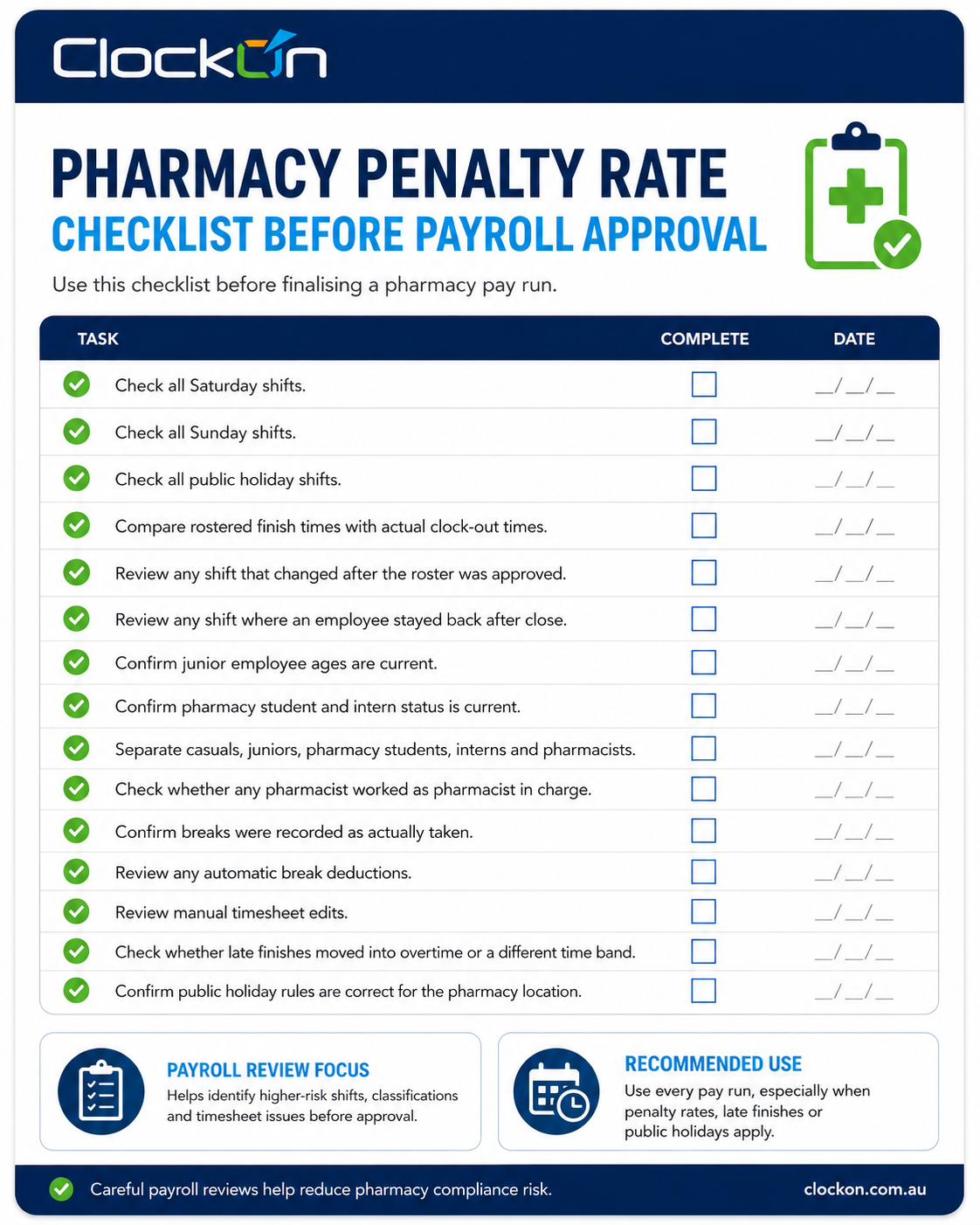
Pharmacy Penalty Rate Checklist Before Payroll Approval
Use this checklist before finalising a pharmacy pay run (click to download file)
Where Pharmacy Payroll Processes Usually Fail
After the high-risk shifts are checked, review the workflow itself.
The issue is often not that the payroll officer does not know the Award exists. The issue is that the roster, time capture and payroll process are not connected well enough to apply the rules consistently.
| Workflow Problem | What to Check | Payroll Risk |
|---|---|---|
| Roster and payroll are separate | Do shift roles and classifications flow into payroll? | The correct employee works the shift but the wrong pay rule applies |
| Clock times are edited manually | Were actual start and finish times preserved? | Late finishes or early starts disappear |
| Employee profiles are not maintained | Are junior ages, student status and pharmacist roles current? | Penalty rates calculate from the wrong base setup |
| Public holidays are handled manually | Are state and location calendars maintained? | A public holiday shift is paid as ordinary time |
| Breaks are assumed, not recorded | Were breaks actually taken? | Paid time may be understated |
| Casuals are grouped together | Are casual assistants, students, juniors and pharmacists separated? | Casual loading is applied but the full Award setup is wrong |
| Spreadsheets are used for adjustments | Can the calculation be audited later? | The same error repeats across future pay runs |
If several of these checks are manual, the payroll risk is not just one incorrect pay run. It is a repeatable process problem.
How ClockOn Helps Reduce Manual Penalty Rate Checks
Pharmacy penalty-rate payroll works best when rostering, time capture and payroll are connected.
ClockOn helps pharmacies reduce manual review by keeping the key payroll inputs in one workflow:
- rostered shifts
- employee roles and classifications
- actual clock-on and clock-off times
- break records
- public holiday handling
- Award interpretation
- payroll processing
That does not remove the need to understand the Pharmacy Industry Award. It reduces the number of places where the same information needs to be re-entered, checked or corrected manually.
For pharmacy operators, the practical benefit is clearer control before payroll is finalised.
The system can help identify the shifts where rules need to apply, instead of relying on someone to manually remember every Saturday, Sunday, public holiday, late finish, junior profile, student shift or pharmacist-in-charge responsibility.
Final Pay Run Review
Before approving a pharmacy pay run, ask one final question:
Which shifts in this pay period were not ordinary weekday shifts worked exactly as rostered?
Those are the shifts to check first.
Look for weekends, public holidays, early starts, late finishes, changed breaks, casual cover, junior employees, pharmacy students, interns, pharmacist-in-charge work and manual timesheet edits.
If those checks are handled manually every pay run, the pharmacy is relying on memory and spreadsheet logic to manage Award risk.
ClockOn helps reduce that risk by applying payroll rules more consistently across rosters, actual time worked and payroll processing, giving pharmacy teams a clearer way to review penalty-rate exposure before payroll is finalised.