
Running payroll without an accounting background doesn’t need to be complicated.
For most Australian business owners, payroll isn’t a specialty. It’s just something that needs to be done accurately, on time, and without friction.
Payroll isn’t difficult because of who runs it
It’s difficult because of the rules behind it
A single pay run can involve:
- PAYG tax calculations
- Superannuation obligations
- Award rates, penalties, and overtime
- Single Touch Payroll (STP) reporting
When handled manually, this creates unnecessary complexity.
The right payroll software removes that burden.
What Makes Payroll Software “Easy”?
Payroll software is only “easy” if it reduces decisions and removes manual work.
The difference is practical:
| Feature | What it means in practice |
|---|---|
| Automatic calculations | Tax, super, and leave handled without spreadsheets |
| Built-in compliance | STP and ATO requirements included in workflow |
| Repeatable workflow | Same process every pay run, no guesswork |
| Award automation | Penalties, overtime, allowances applied automatically |
| Error prevention | Issues flagged before payroll is finalised |
| Local support | Help from people who understand Australian payroll |
Ease of use isn’t about fewer features
It’s about fewer decisions
Why Payroll Feels Complex at First
Payroll complexity comes from variation, not ability.
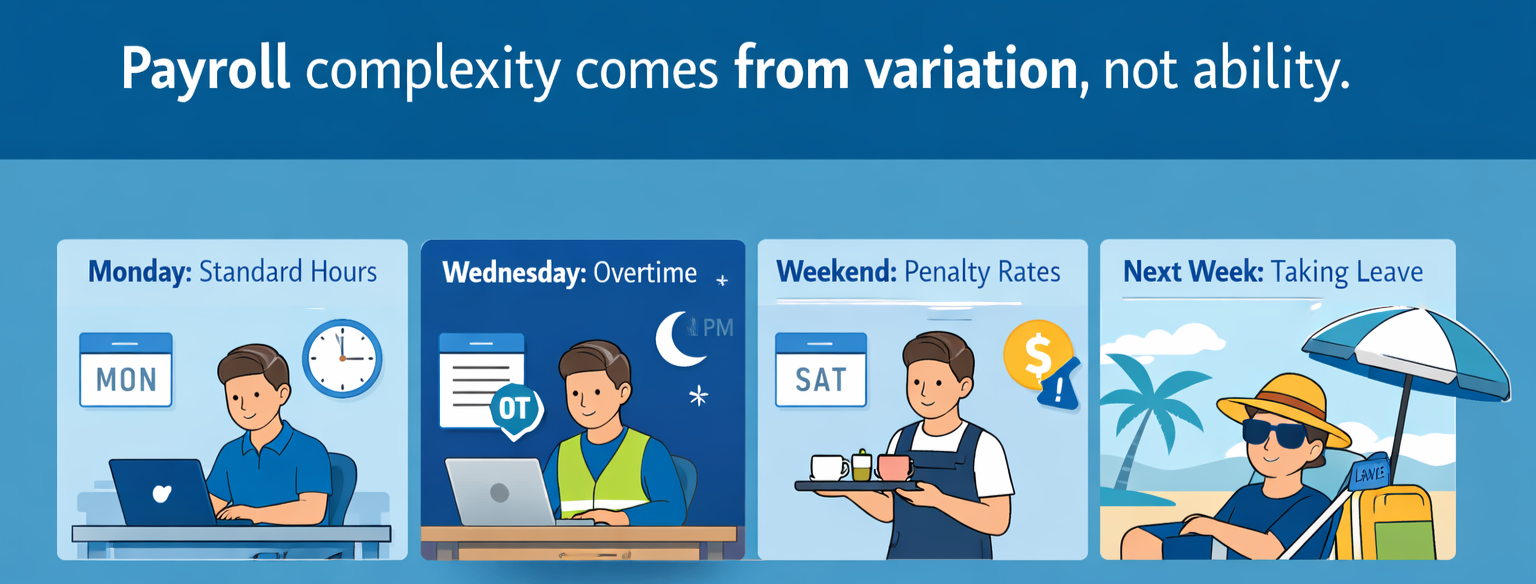
A single employee might:
- Work standard hours on Monday
- Overtime on Wednesday
- Weekend shifts with penalties
- Take leave the following week
Each of these changes how they should be paid.
Now multiply that across a team.
Add:
- Multiple roles
- Different locations
- Changing rosters
And suddenly payroll becomes something you feel like you need to double-check every time.
The goal isn’t to understand every rule
It’s to use a system that already does
The 3 Types of Payroll Systems (And How They Feel)
Not all payroll systems are built the same way. This directly impacts how easy they are to use.
1. Accounting Software with Payroll Add-Ons
- Built for financial reporting first
- Payroll is secondary
- Works well for simple salaried teams
Limitation:
Requires more interpretation when pay conditions vary
2. Time Tracking + Payroll Integrations
- Rosters and timesheets in one system
- Payroll in another
Limitation:
- Requires syncing and mapping
- Higher risk of mismatches
- Extra steps each pay run
3. All-in-One Payroll Systems
- Rostering, timesheets, payroll, compliance in one workflow
- No data re-entry
Advantage:
- Fewer systems
- Fewer decisions
- More consistent outcomes
The fewer systems involved, the simpler payroll becomes
.png?width=1000&height=300&name=Workforce%20Management%2c%20Simplified.%20(2).png)
Comparing Popular Payroll Software in Australia
This isn’t about which system is “best”
It’s about where each one feels simple
| Platform | Where it feels easy | Where it becomes complex |
|---|---|---|
| Xero Payroll | Salaried teams, low variation | Awards, penalties, detailed timesheets |
| MYOB | Accountant-supported businesses | Self-managed payroll setup |
| Deputy + Payroll | Rostering and scheduling | Syncing payroll across systems |
| Employment Hero | All-in-one HR/payroll | Managing varied awards |
| ClockOn | Shift-based teams, compliance-heavy payroll | Job costing for industries such as NDIS |
The key difference:
Does the system handle the complexity — or do you?
What Payroll Looks Like When It’s Actually Simple
A simplified payroll workflow should look like this:
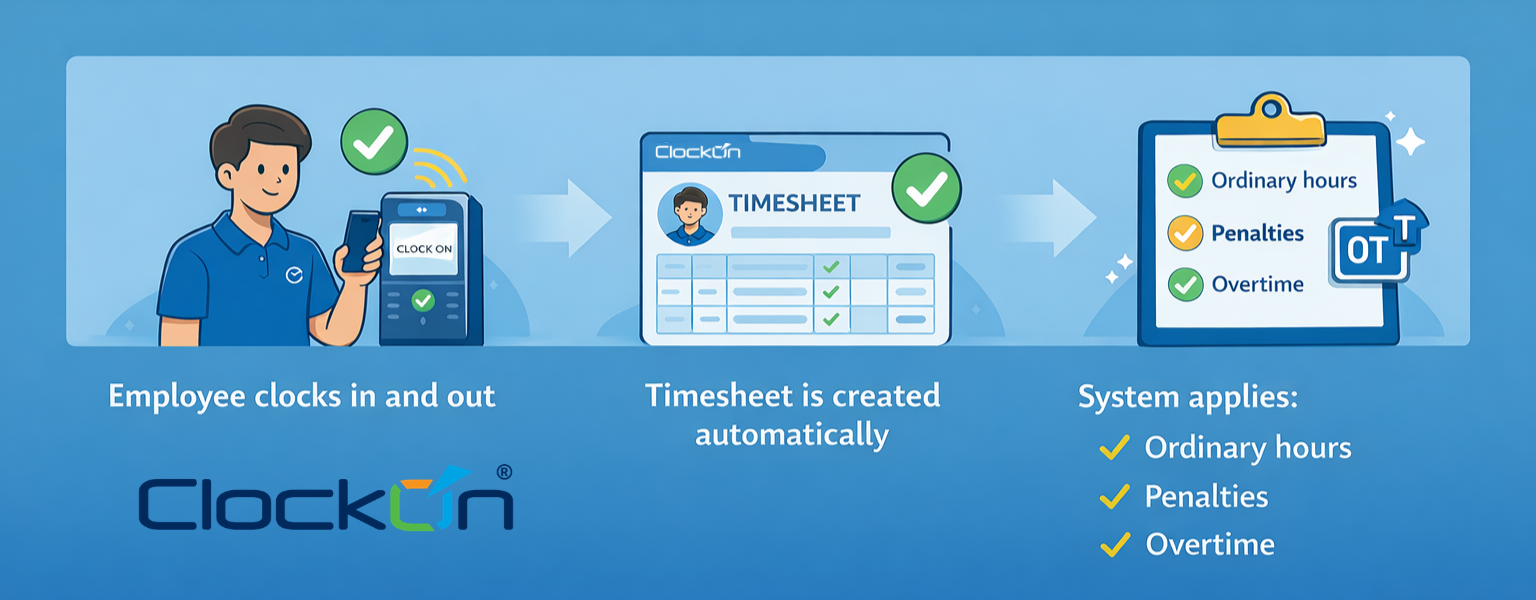
End-to-end flow:
- Employee clocks in and out
- Timesheet is created automatically
- System applies:
- Ordinary hours
- Penalties
- Overtime
- Manager reviews and approves
- Payroll is processed
- STP is submitted automatically
✔ No re-entry
✔ No manual interpretation
✔ No separate compliance step
Same process every time
Regardless of complexity behind the scenes
A Simpler Approach to Payroll
For business owners, simplicity comes down to one thing:
How many decisions do you need to make each pay run?
ClockOn is designed to reduce that number.
What that looks like:
- Timesheets flow directly into payroll
- Award conditions apply automatically
- Compliance checks happen before finalisation
- STP is built into the workflow
The detail still exists
It’s just handled inside the system
FAQs
Can I run payroll without an accountant?
Yes. Modern payroll systems handle tax, super, STP reporting, and award rules within the platform, reducing the need for external support.
What payroll software handles super payments?
Some systems include integrated clearing house functionality, allowing super to be processed directly within payroll.
Do I need to understand awards to run payroll?
No. Systems with award interpretation apply rules automatically based on hours worked.
What’s the biggest time-saving feature?
Timesheets connected directly to payroll
This removes:
- Manual entry
- Reconciliation
- Common errors
Final Thoughts
The easiest payroll system isn’t the one with the simplest interface.
It’s the one that makes payroll:
- Clear
- Repeatable
- Reliable
When calculations are automatic
When compliance is built in
When workflows are connected
Payroll stops being something you manage
And becomes something that simply runs

☝️ ClockOn's starter package is FREE for up to 12 months.
Start for free, today!