







 How ClockOn Works
 Feature list
 Templates
 For Accountants
 Payday Super
 About Us
 Blog
Blog Integrations
 Press Releases
 Help Centre
 Professional Services
 Setup Service
 Training
ClockOn vs Employment Hero
Smarter award logic with less manual input.
.png.png "clockon logo blue.ai (1500 x 300 px).png")

Choosing between Employment Hero and ClockOn isn’t just about features — it’s about how each system handles award complexity.
Both platforms process payroll and support awards. The key difference lies in how they interpret pay conditions, manage work types and apply rules during a shift.
For award-heavy businesses, the difference directly affects accuracy, admin time and compliance risk - and this comparison highlights why ClockOn’s rule-driven interpretation model places less burden on staff and better supports complex payroll environments.
‣ Core Difference
Employment Hero
Interprets pay conditions based only on what the employee or manager explicitly records per time block — via work types.
ClockOn
Interprets award pay conditions based on role, classification, and context, and automatically applies appropriate rules to a timesheet without needing multiple punches unless genuinely required.
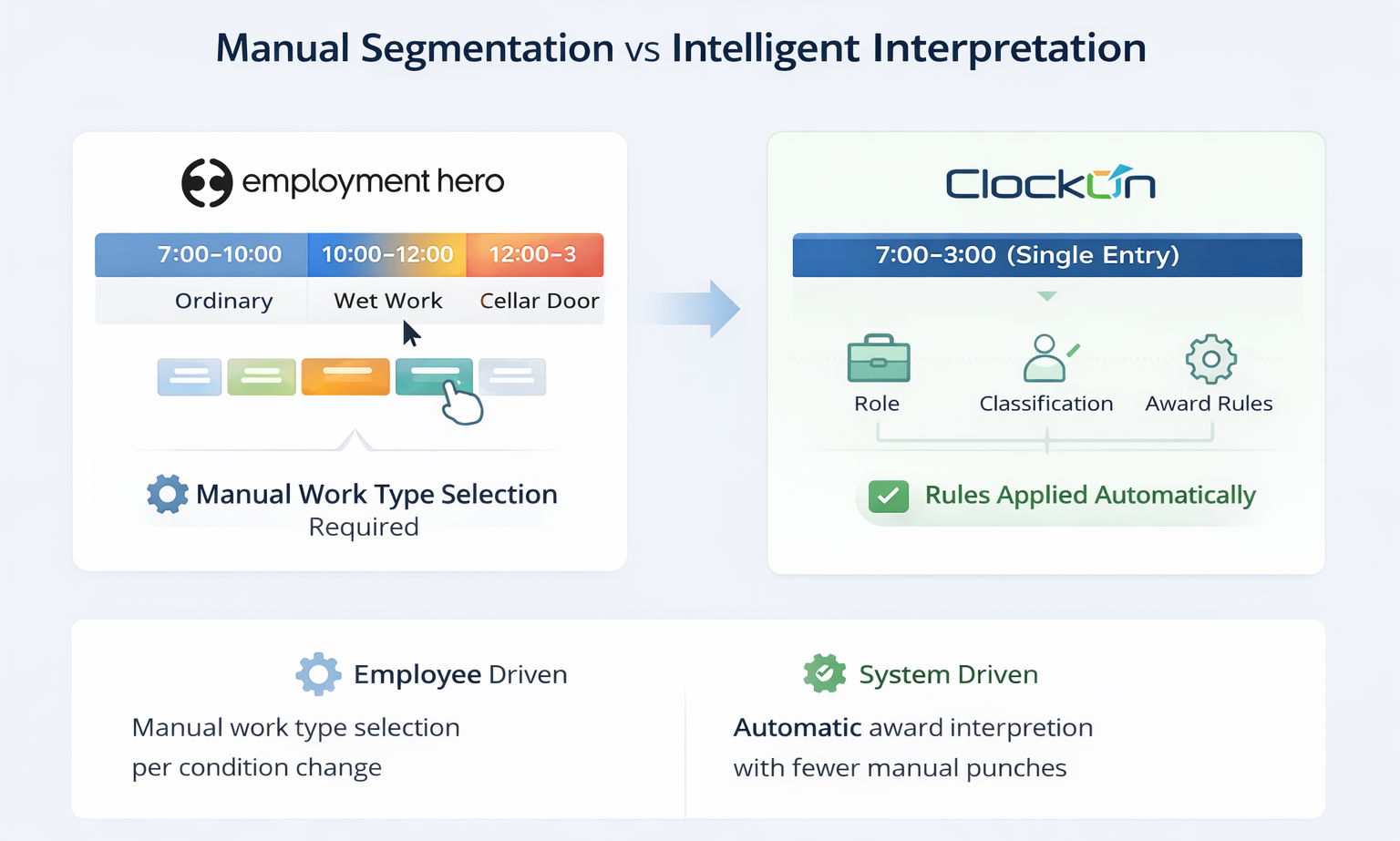
So the fundamental contrast is: Employment Hero requires manual work type segmentation per condition change. ClockOn uses rules that interpret the time entry holistically with less manual tagging
This distinction becomes more important in industries operating under complex awards - hospitality, wineries, healthcare, retail, clubs and multi-classification environments.
‣ How Work Types / Duty Changes Are Handled
Employment Hero
Each condition change must be explicitly recorded with a separate work type.
If duties change during a shift, the employee or supervisor must split the time manually.
The payroll engine won’t infer a duty change or automatically split the shift.
If only one work type is selected for a long shift with mixed duties, allowances or penalties can be missed.
Result: Multiple entries or toggles required during the day.
For businesses with highly structured shifts and consistent duties, this approach can work well. It offers visibility and control — but it relies heavily on user accuracy.
ClockOn
Timesheets can remain a single continuous entry, and ClockOn’s award interpretation evaluates them based on:
• Employee attributes such as classification and employment type
• Time thresholds
• Rules embedded in the award logic
• Conditions such as overtime triggers, penalties and minimum breaks
ClockOn will automatically:
• Split hours internally for pay calculation if the award requires it
• Apply allowances or penalties based on the context of total hours
• Identify overtime without requiring the user to split the entry
Result: Employees rarely need multiple punches just to trigger an award condition.
For businesses with rotating duties, seasonal staff, or employees who may not consistently tag work types correctly, this reduces compliance risk.
‣ Example Comparison
Scenario:
Winery worker [MA000090] starts at 7 am, does general tasks until 10 am, then wet work until 12 pm, and finishes cellar door until 3 pm.
Employment Hero
You must record 3 segments:
0700–1000 (Ordinary)
1000–1200 (Wet work)
1200–1500 (Cellar door)
If you don’t split, the system only applies one condition.
This gives strong visibility, but accuracy depends on correct tagging.
ClockOn
You can record:
0700–1500 (single entry)
ClockOn’s award logic then determines:
• Overtime and penalty rates based on thresholds and time of day
• Public holiday and stacked rate conditions
• Allowances such as wet work where triggered by configured rules or role settings
No need to manually segment unless duties structurally require it.
For wineries, hospitality venues, and multi-award environments, this significantly reduces admin overhead — particularly during peak periods like harvest or public holidays.
‣ How the Rule Engines Differ
Employment Hero
Works on flags attached to each timesheet line
Will not guess or segment
Only pays what it sees explicitly marked
This approach gives structured control but increases reliance on staff input accuracy.
ClockOn
Works on award logic first
Uses conditions and triggers to assess even unsegmented time
Splits internally for calculation where required
Only asks for segmentation where the award structurally requires it, not simply for allowance flags.
For businesses concerned about underpayments caused by missed work types, this interpretive model can provide a safety net.
‣ Practical Impacts
Ease of Use
| System | Employee burden | Manager burden |
|---|---|---|
| Employment Hero | Higher | Medium |
| ClockOn | Lower | Lower |
Employees in Employment Hero often need to remember to toggle conditions mid-shift. It's accurate if duty changes are recorded correctly, but risk increases if employees forget to switch work types
ClockOn relies less on user memory. The interpretive engine captures more award conditions automatically. Staff often only need to record time (not condition logic).
For high-turnover industries or seasonal staff, reducing employee input complexity can improve payroll accuracy.
‣ When Each System May Suit
Employment Hero may suit:
- Businesses with simple awards
- Stable, consistent duties
- Teams comfortable with structured work type tagging
- Organisations willing to rely on manual work type tagging for pay accuracy
ClockOn may suit:
- Award-heavy industries
- Businesses with rotating duties
- Hospitality, wineries, clubs, healthcare
- Employers wanting reduced manual tagging
- Organisations prioritising compliance, safety, and automation
Ready to switch?
Implementation Service
Accuracy, compliance, and smooth adoption
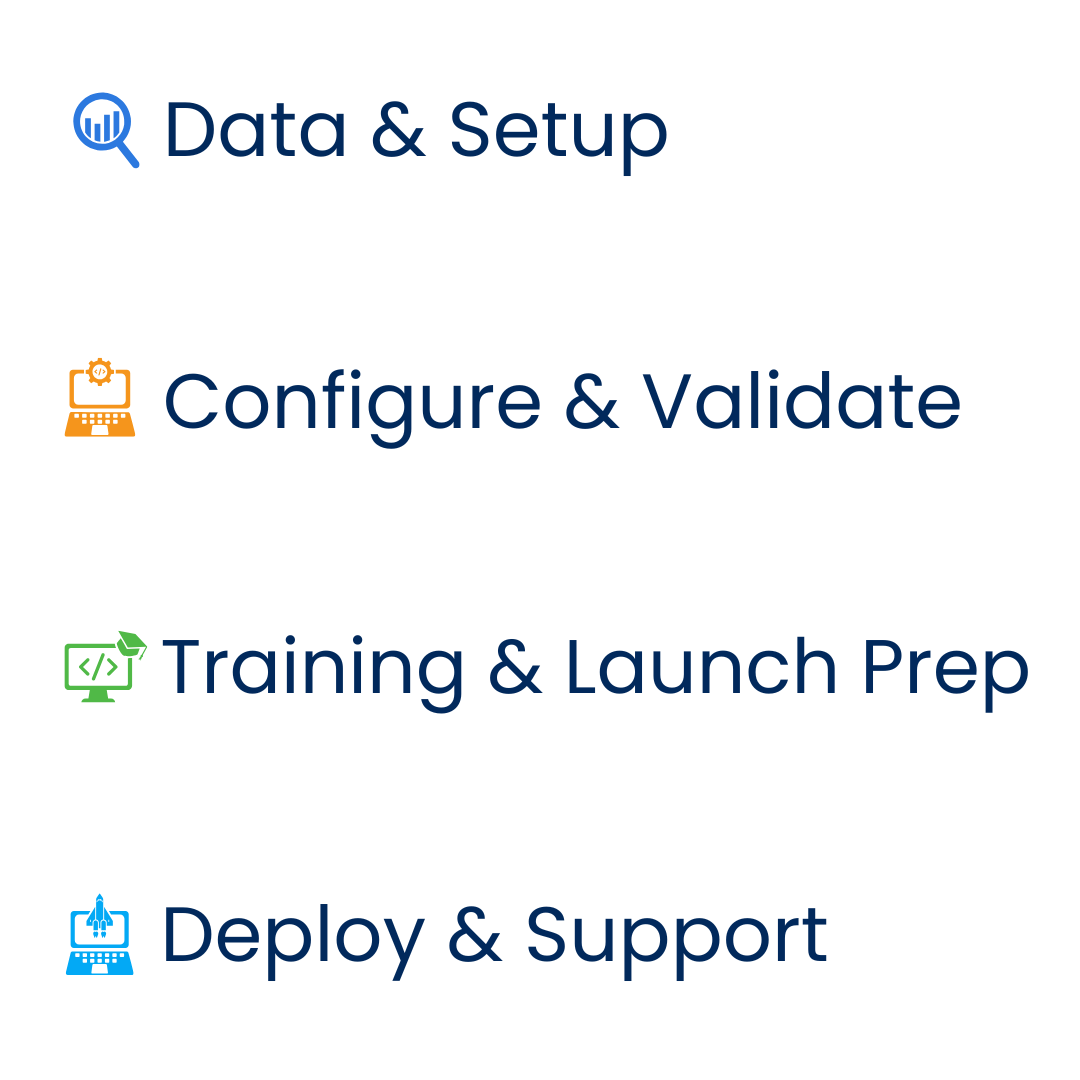
Work hand-in-hand with ClockOn’s implementation specialists through a clear, step-by-step process designed to get your team trained, compliant, and confidently processing payroll.
You'll be up and running in just a few weeks.
Trusted by businesses great and small




"The support from ClockOn during the implementation and change-over period was exceptional; the training provided was concise and the system itself very user friendly"
⭐⭐⭐⭐⭐