
When a workplace incident happens, the first priority is the safety of the people involved. After that, employers need to work out what should be recorded internally, whether a regulator must be notified and what needs to happen next.
The difficult part is that there is no single incident reporting process that applies exactly the same way across Australia. Most states and territories operate under legislation based on the model Work Health and Safety (WHS) laws, while Victoria has its own occupational health and safety framework. Local requirements can also change independently. Safe Work Australia confirms that the model laws have been implemented in every Australian jurisdiction except Victoria.
Workplace incident reporting is the process of recording, escalating, investigating and responding to workplace safety events. Some incidents must also be reported to the relevant state, territory or Commonwealth regulator. An internal incident report and a statutory regulator notification are separate processes.
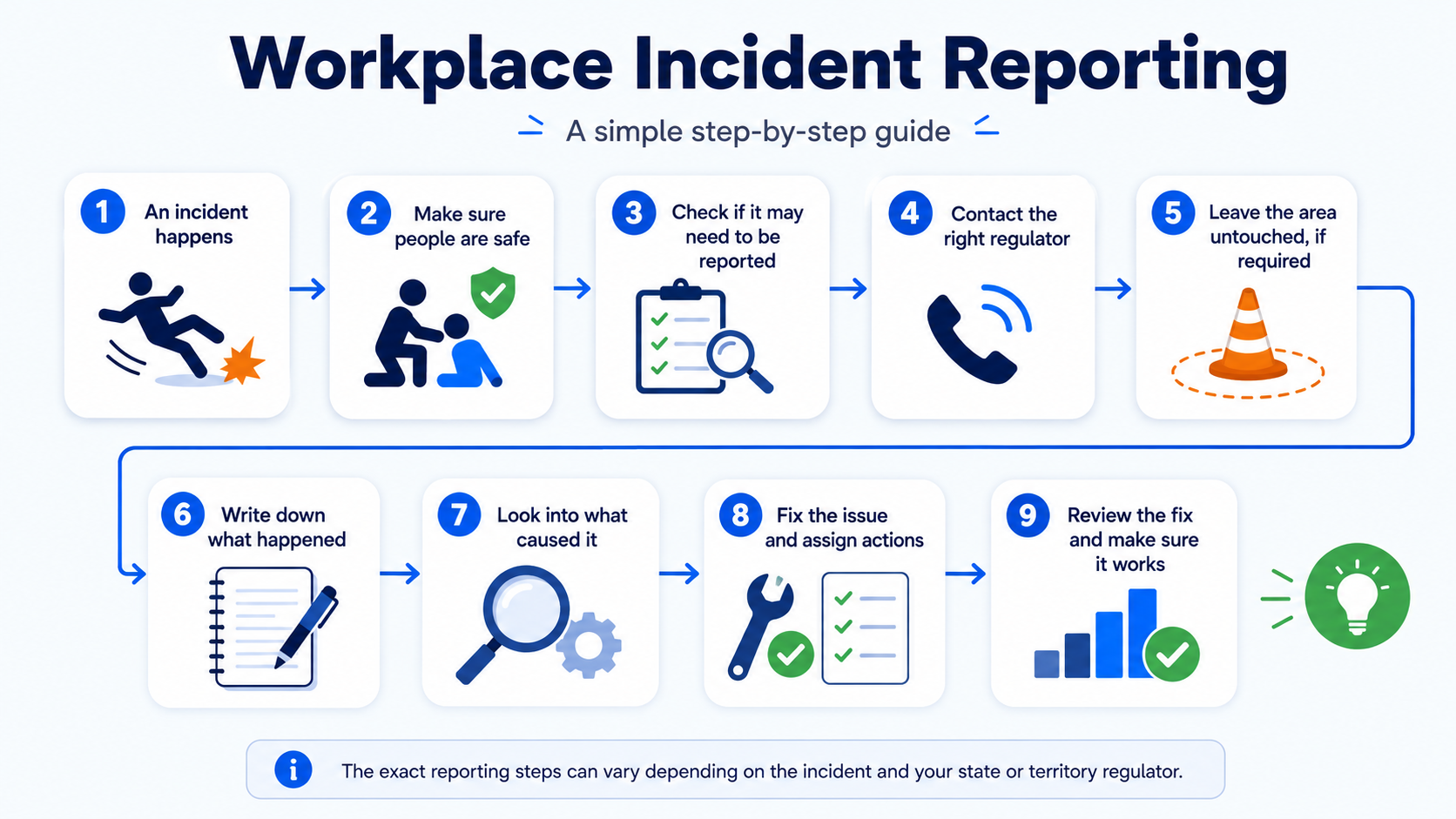
A useful starting point if you've just experienced an incident:
Incident, hazard, near miss or notifiable incident: what's the difference?
Not everything reported internally needs to be reported to a regulator.
| Term | Plain-English meaning | Usually record internally? | Could require regulator notification? |
|---|---|---|---|
| Hazard | Something with the potential to cause harm | Yes | Usually not by itself |
| Near miss | An event where someone could have been injured but wasn't | Yes | Possibly, depending on the circumstances |
| Injury or illness | A person has been harmed | Yes | Depends on severity and circumstances |
| Dangerous incident | An event exposing someone to a serious risk, where statutory criteria are met | Yes | Potentially |
| Notifiable incident | An incident that meets the legal threshold for notification | Yes | Yes |
These categories can overlap.
For example, a forklift narrowly missing a warehouse worker should generally be recorded and investigated internally. Whether it also meets the legal definition of a dangerous or notifiable incident depends on what happened and the law applying in that jurisdiction. Queensland's regulator specifically notes that an incident is not notifiable simply because it occurred at or near a workplace. It must be connected to the work or conduct of the business.
What workplace incidents need to be notified?
Under the established model WHS framework, a PCBU must notify its WHS regulator after becoming aware of certain workplace:
- deaths
- serious injuries or illnesses
- dangerous incidents
The notification is generally required immediately after the PCBU becomes aware of the notifiable incident. Safe Work Australia provides national guidance on these concepts, but Safe Work Australia is not the organisation an employer reports an incident to. Notifications go to the applicable state, territory or Commonwealth regulator.
What counts as a serious injury, illness or dangerous incident is defined in legislation and regulator guidance. Do not assume an incident is notifiable purely because someone was injured, or that no notification is required because nobody was hurt.
▶Have workplace incident notification rules changed in 2026?
Yes, at the model-law level.
In December 2025, Safe Work Australia published amendments to the model WHS Act that broadened model incident-notification requirements. The updated model framework includes areas such as:
- dangerous incidents involving mobile plant and falls
- certain violent incidents, including sexual assault
- work-related suicide and attempted suicide
- extended worker absences of 15 or more calendar days
Important: Changes to the model WHS Act do not automatically become law in each state and territory. Individual jurisdictions must adopt them into their own laws, and their implementation dates can differ. Employers should therefore check their local regulator's current guidance rather than changing their reporting process based on the model Act alone.
There are already local differences. For example, amendments to ACT incident-notification laws commenced on 19 November 2025 and include workplace sexual assault incidents, including suspected incidents, within its notification framework.
Is this workplace event reportable?
| Event | Example | Record internally? | Potential regulator notification? | Next step |
|---|---|---|---|---|
| Hazard | Damaged flooring in a retail store | Yes | Usually not | Fix or control the hazard and record what was done |
| Near miss | Forklift narrowly misses an employee | Yes | Possibly | Investigate and check dangerous-incident criteria |
| Minor injury | Small superficial kitchen burn treated with first aid | Yes | Depends on facts | Record and address the cause |
| Serious injury | Worker suffers a serious fall requiring urgent treatment | Yes | Potentially yes | Check/contact the regulator immediately |
| Dangerous event | Serious plant failure exposes workers to significant risk | Yes | Potentially yes | Check the jurisdiction's notification criteria immediately |
If the facts are unclear, contact the relevant regulator for advice. Do not wait for a full internal investigation before checking whether notification is required.
What should you do immediately after a workplace incident?
▶Step 1: Protect people and make the area safe
Deal with the immediate risk first.
Provide first aid, call 000 when emergency assistance is needed and prevent other workers or members of the public from being exposed to the hazard.
Record keeping should never delay emergency treatment.
▶Step 2: Decide whether regulator notification may be required
Ask:
- Has someone died?
- Is there a serious injury or illness?
- Was someone exposed to a serious or immediate risk?
- Could a newer notification category apply in this jurisdiction?
- Are there industry-specific notification requirements?
- Which regulator covers this workplace?
If the answer is uncertain, check the current guidance from the regulator where the incident occurred.
▶Step 3: Notify the correct regulator
Do not send the notification to Safe Work Australia.
Safe Work Australia develops national policy and the model WHS laws. Workplace safety regulation and enforcement sit with Commonwealth, state and territory authorities. Its regulator directory is a useful starting point for finding the correct authority.
▶Step 4: Preserve the site where required
A notifiable incident can trigger site-preservation obligations.
The details differ by jurisdiction, but employers may need to leave the site undisturbed until an inspector arrives or the regulator gives permission. Common exceptions allow necessary action to help an injured person, remove a deceased person, protect health and safety or make the site safe.
For example, SafeWork NSW instructs businesses not to disturb a notifiable incident scene until an inspector arrives or gives a direction, subject to those safety-related exceptions.
▶Step 5: Record what happened
Capture the information while it is still fresh. This is where a consistent internal reporting process matters, even when an event does not require external notification.
▶Step 6: Investigate and take corrective action
Incident reporting establishes what happened. Investigation should help establish why it happened and what needs to change.
The depth of an investigation should reflect the seriousness and potential consequences of the incident. A minor hazard may need a straightforward review. A serious event may require a much more detailed investigation.
Look at the immediate circumstances, contributing factors, existing controls and whether those controls were adequate and followed.
Then assign corrective actions, including an owner, due date and completion record.
Who is responsible for reporting a workplace incident?
Workers are usually the first link in the internal reporting process. They should know how to report injuries, incidents, hazards and near misses promptly.
Supervisors and managers then need to make the situation safe, capture the relevant information and escalate serious events through the organisation's notification process.
Business owners, HR teams or WHS managers may handle the administrative work involved in determining notification requirements, contacting regulators and maintaining records.
That delegation does not remove legal duties from the relevant duty holder. Under model WHS laws, notification responsibility sits with the PCBU where the statutory requirements are met.
What should be included in a workplace incident report?
A useful incident record should show not only what happened, but what the business did afterwards.
| Information | What to capture | Why it matters |
|---|---|---|
| Event | Date, time, location, category and description | Establishes the basic facts |
| People | Person involved, witnesses, supervisor and reporter | Identifies who can provide information |
| Consequences | Injury, illness, treatment, time away and property damage | Records the outcome |
| Immediate response | First aid, emergency response, isolation and regulator contact | Shows what happened immediately afterwards |
| Evidence | Photos, documents, statements or other files | Supports later investigation |
| Investigation | Contributing factors and relevant controls | Helps identify what should change |
| Corrective action | Action, owner, due date and status | Makes follow-up accountable |
| Completion | Evidence of completed action and review | Shows that the matter was closed |
Paper forms, email chains and spreadsheets can all hold this information, but they become difficult to manage when evidence and follow-up actions are stored separately.
A structured HR software system can make those records easier to organise alongside the employee information they relate to.
The following walkthrough demonstrates on how employees can use this feature in ClockOn:
How long should workplace incident records be kept?
There is no safe blanket rule that every workplace incident document in Australia must be kept for the same period.
Retention depends on the type of record, the applicable jurisdiction, workers' compensation requirements and any industry-specific obligations.
For example, SafeWork NSW states that a record of a notifiable incident must be retained for at least five years, while Victoria requires written records of applicable notifiable incidents to be retained for at least five years.
Businesses operating in more than one state should document the retention rules that apply to each operation rather than relying on a single national assumption.
Workplace incident reporting rules by state and territory
The regulator depends on where the workplace sits and, in some cases, the industry.
| Jurisdiction | Regulator | Main legislative framework | Where to check |
|---|---|---|---|
| NSW | SafeWork NSW | Work Health and Safety Act 2011 | Current incident notification guidance |
| Victoria | WorkSafe Victoria | Occupational Health and Safety Act 2004 | Victorian notifiable incident rules |
| Queensland | Workplace Health and Safety QLD | Work Health and Safety Act 2011 | Queensland notification guidance |
| Western Australia | WorkSafe WA | Work Health and Safety Act 2020 | WA notifiable incident guidance |
| South Australia | SafeWork SA | Work Health and Safety Act 2012 | SA workplace incident notifications |
| Tasmania | WorkSafe Tasmania | Work Health and Safety Act 2012 | Tasmania notification guidance |
| ACT | WorkSafe ACT | Work Health and Safety Act 2011 | ACT incident notification guidance |
| Northern Territory | NT WorkSafe | Work Health and Safety (National Uniform Legislation) Act 2011 | NT incident notification guidance |
| Commonwealth | Comcare | Work Health and Safety Act 2011 (Cth) | Comcare notification guidance |
Safe Work Australia confirms that Victoria is the only jurisdiction that has not implemented the model WHS laws. Even among jurisdictions that have, local variations can apply.
Specialised industries may also have different or additional regulators. Mining, petroleum, electrical work and other regulated activities are common examples.
▶Why Victoria needs separate treatment
Victoria operates under the Occupational Health and Safety Act 2004, rather than legislation based on the model WHS Act.
WorkSafe Victoria requires applicable notifiable incidents to be reported immediately. A written notification must then be provided within 48 hours, with a copy kept for at least five years.
That is why a national incident policy still needs a jurisdiction check built into it.
Workplace incident reporting vs workers' compensation reporting
These processes are related, but they are not interchangeable.
| Process | Purpose | Who it goes to |
|---|---|---|
| Internal incident report | Record, investigate and follow up the event | Employer |
| WHS/OHS notification | Meet statutory workplace safety notification requirements | Applicable safety regulator |
| Workers' compensation notification or claim | Manage workplace injury insurance and compensation | Insurer or relevant scheme |
One event can trigger all three.
For example, NSW guidance separately requires the notification of qualifying incidents to SafeWork NSW and notification to the workers' compensation insurer. Other jurisdictions have their own workers' compensation processes and deadlines.
Common workplace incident reporting mistakes
A few mistakes cause most of the practical problems.
Waiting until the investigation is finished can create a serious issue if the incident was supposed to be notified immediately.
Reporting to Safe Work Australia rather than the relevant regulator is another. Safe Work Australia itself states that it cannot accept or advise on workplace incident notifications.
Other common gaps include treating every event as legally notifiable, failing to record useful near misses internally, disturbing a site too early and recording the original incident without documenting the corrective actions that followed.
For multi-state employers, there is another risk: copying one state's reporting procedure across the entire business without checking local requirements.
How can incident records improve workforce management?
Incident records can also give employers a reason to investigate what was happening around an event.
Suppose incidents appear disproportionately during long shifts, overnight work or periods of heavy overtime. That does not prove fatigue caused them, but it gives the business a reason to review the roster, attendance records, workload and other contributing factors.
The same applies when incidents cluster at one location, within one department or around a particular task.
Reviewing safety records alongside rostering software and time and attendance software data can provide useful context around who was working, when they were working and the hours involved.
The goal is not to find a convenient explanation. It is to give an investigation better information.
How incident management software can help
The administrative problem with incident reporting is often fragmentation.
A worker tells their manager what happened. Photos remain on someone's phone. The incident form is saved in a folder. The investigation is written in another document. Someone emails a corrective action to a supervisor and, three months later, nobody is certain whether it was completed.
A structured incident-management system gives the business one record to work from.
Useful features include:
- separate incident, near-miss and hazard records
- supporting document and photo attachments
- corrective action tracking
- assigned responsibility
- status tracking
- searchable historical records
- controlled user access
- an audit trail
- connections with broader employee records
Software does not determine whether an incident is legally notifiable, and it does not replace WHS advice or the regulator. Its role is to make the internal process easier to follow and document.
Building a more audit-ready incident process with ClockOn
ClockOn Incident Management is part of ClockOn HR Pro and gives employers a central place to record incidents, near misses and hazards alongside their broader HR records.
Businesses can attach supporting documents and evidence to an incident, record corrective actions, track follow-up and retain an audit history of investigation steps and outcomes.
That matters because good incident management does not end when someone fills in a form. You need to be able to see what happened, what evidence was collected, what action was assigned and whether that action was completed.
See how ClockOn HR software can help bring incident and workforce records into one structured system.
Incident reporting audit check
- Workers know what events should be reported internally
- Reporting responsibilities are clearly defined
- The organisation has a process for assessing whether regulator notification is required
- Regulator contact details are current for every jurisdiction in which the business operates
- Site-preservation requirements are included in the response procedure
- Incident records use a consistent set of fields
- Photos and supporting evidence can be retained with the record
- Investigations have an assigned owner
- Corrective actions have owners and due dates
- Completed actions are documented
- Record-retention rules have been checked for the relevant jurisdiction
- The procedure is reviewed when legislation or operations change
Frequently asked questions
▶What is a notifiable workplace incident in Australia?
A notifiable incident is a workplace event that meets the statutory threshold for reporting to the applicable safety regulator. Under the established model WHS framework, this includes specified deaths, serious injuries or illnesses and dangerous incidents. The exact legal definition should always be checked against the law in the jurisdiction where the event occurred.
▶How quickly must a notifiable incident be reported?
Where an incident is legally notifiable, notification will generally need to happen immediately or as soon as required by the applicable jurisdiction. Do not wait until your internal investigation is complete. Check the current regulator guidance for the state or territory where the incident happened.
▶Who do I report a workplace incident to?
Notifiable workplace incidents are reported to the applicable state, territory or Commonwealth safety regulator, not Safe Work Australia. For example, NSW businesses generally deal with SafeWork NSW, Victorian employers with WorkSafe Victoria and relevant Commonwealth employers with Comcare. Safe Work Australia's regulator directory can help identify the appropriate authority.
▶Do workplace near misses need to be reported?
Near misses should generally be captured through the employer's internal reporting process because they can expose hazards that need attention. That does not mean every near miss must be notified to a regulator. External notification depends on whether the circumstances meet the relevant statutory definition, such as a dangerous incident.
▶What information should be included in a workplace incident report?
Record when and where the event occurred, who was involved, what happened, injuries or treatment, witnesses, immediate actions, relevant equipment or conditions and any supporting evidence. The record should also cover investigation findings, corrective actions, responsibility, due dates and evidence that those actions were completed.
▶How long should workplace incident records be kept?
There is no single retention period for every type of incident record across Australia. Requirements depend on the record and jurisdiction. For example, relevant notifiable incident records in NSW and Victoria are subject to five-year retention requirements. Employers should also check workers' compensation and industry-specific record rules.
▶What is the difference between an incident report and a workers' compensation claim?
An internal incident report documents and investigates what happened. WHS or OHS notification is a separate legal process for incidents meeting statutory notification criteria. Workers' compensation deals with injury insurance and compensation. A single workplace injury can trigger all three, but the authorities, forms and deadlines may be different.
▶Can HR software be used to manage workplace incident reports?
Yes. HR software can support the internal record-keeping side of incident management by centralising incident details, supporting evidence, corrective actions and follow-up history. It does not decide whether an incident is legally notifiable or replace the employer's obligation to contact the appropriate regulator when required.