
In August 2026, the Federal Court of Australia acknowledged it had underpaid 248 current and former casual employees after a payroll configuration issue dating back to August 2018.
The problem was not a missing timesheet or an obviously incorrect hourly rate. Casual employees who worked fewer than four hours were paid for the time they recorded, even though the relevant enterprise agreements required a minimum four-hour engagement.
The average gross underpayment was estimated at about $219 per affected employee, excluding interest. Once superannuation and interest are included, total remediation payments are expected to reach approximately $77,000.
What makes the case particularly useful for payroll teams is that the timesheets themselves could be completely accurate. An employee could work two hours, correctly record two hours and still be underpaid because the payroll result should have reflected a four-hour minimum entitlement.
Hours worked are not always the same as hours an employee is entitled to be paid.
For employers, that is the real warning. A payroll system can receive accurate attendance data and use the correct hourly rate, yet still produce the wrong pay when an Award or enterprise agreement condition sitting between attendance and payroll is not interpreted correctly.
What happened in the Federal Court payroll underpayment?
The Federal Court said the issue affected 152 former employees and 96 current employees from August 2018 onwards.
The affected employees were casuals who had recorded fewer than four hours on their timesheets. Their relevant enterprise agreements required a minimum four-hour engagement, but that entitlement was not being reflected correctly in payroll.
The basic problem looks like this:
| Hours recorded | Minimum engagement | Hours that should be paid |
|---|---|---|
| 1.5 hours | 4 hours | 4 hours |
| 2 hours | 4 hours | 4 hours |
| 3.25 hours | 4 hours | 4 hours |
| 4.5 hours | 4 hours | 4.5 hours |
The current Federal Court of Australia Enterprise Agreement 2024-2027 continues to state that a casual employee must either be engaged for at least four hours or paid for a minimum of four hours at the appropriate casual rate.
So a timesheet showing two hours can be completely accurate.
The payroll result can still be wrong.
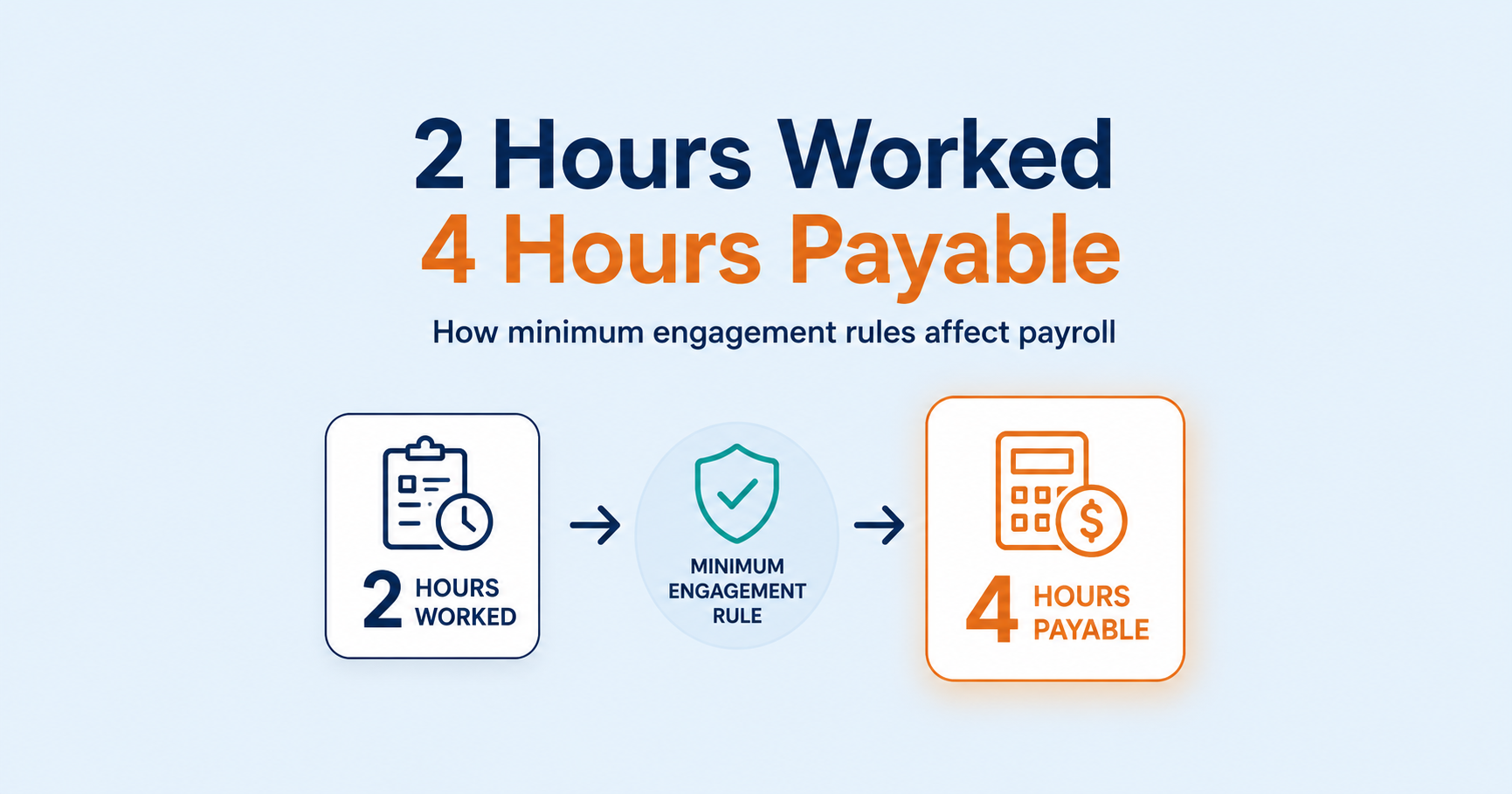
Why two hours worked can mean four hours payable
A minimum engagement rule sets the minimum amount an employee must be engaged or paid for when they attend work.
Imagine a casual employee clocks in at 10:00 am and leaves at 12:00 pm.
The time and attendance system correctly records 2 hours worked.
If the employee's applicable enterprise agreement requires a minimum four-hour engagement, payroll then has to interpret those two recorded hours as 4 hours payable.
The additional two hours are not missing attendance. They arise from an employment condition.
A timesheet answers “what happened?”
Payroll interpretation has to answer “what does that mean for pay?”
How it flows: 2 hours worked → 2 hours recorded → minimum engagement rule checked → 4 hours payable → payroll calculated
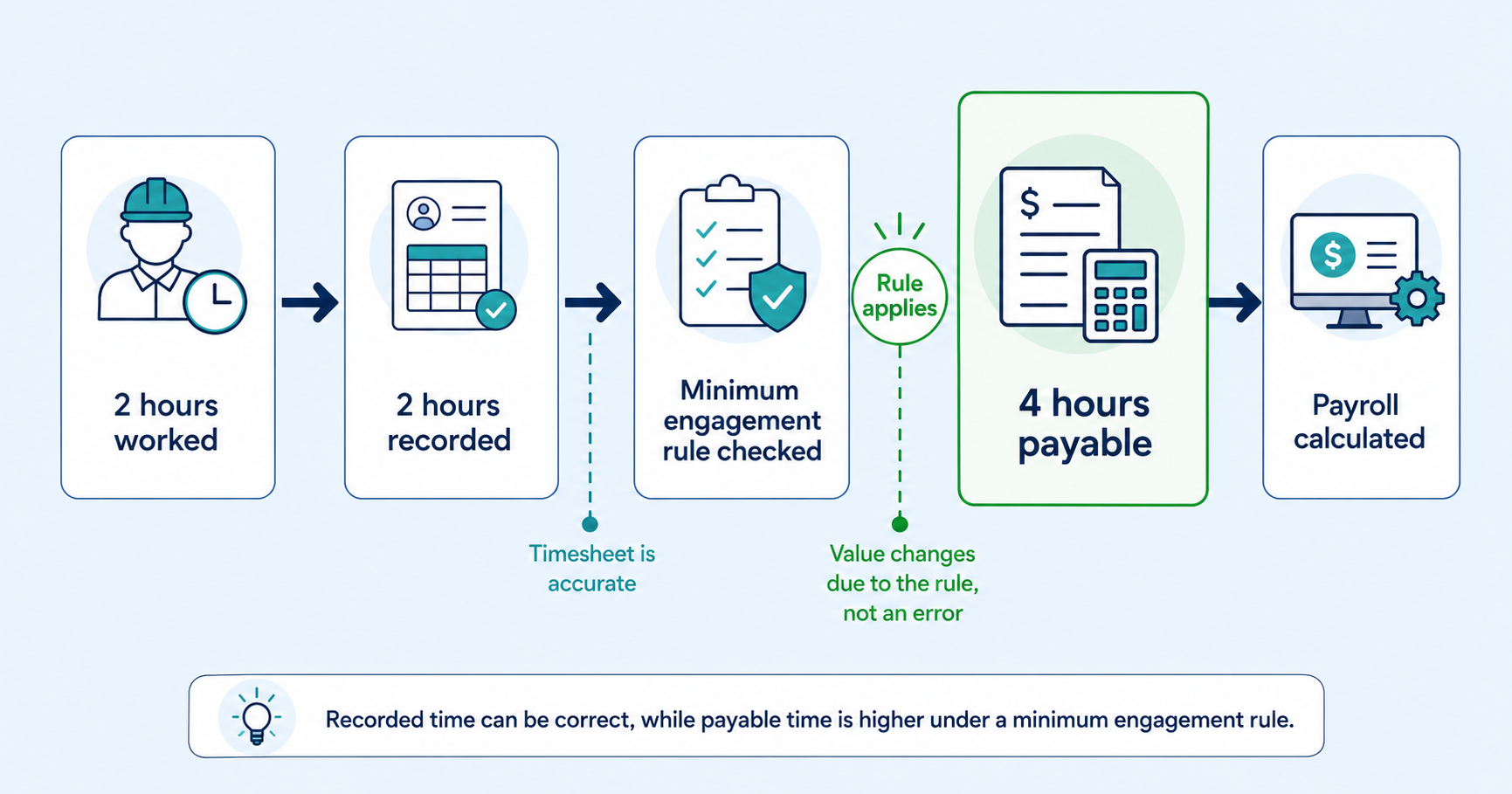
This is why payroll is not always as simple as:
Hours × hourly rate = pay
For an Award or agreement-covered workforce, a more realistic workflow is:
Employment conditions → employee classification → attendance → payroll rules → payable hours and rates → payroll
Accurate attendance is therefore only one part of an accurate pay result.
Minimum engagement rules are not the same everywhere
The Federal Court case involves a four-hour minimum, but Australian businesses should not treat four hours as a universal rule for casual employees.
Minimum engagement provisions vary between Modern Awards, enterprise agreements and employee classifications.
| Industrial instrument | Example minimum engagement |
|---|---|
| Hospitality Industry (General) Award | At least two consecutive hours for casual employees on each occasion they attend work |
| Hair and Beauty Industry Award | Three consecutive hours minimum daily engagement for casual employees |
| Meat Industry Award | Generally four hours for casual employees, with different provisions applying to some cleaners and clerks |
That variation is exactly why a generic instruction such as “pay casual employees for the hours on their timesheet” can fail.
The applicable Award, enterprise agreement, classification and employment arrangements need to be understood first.
Fair Work explains that most employees receive pay and entitlements from an Award or enterprise agreement, alongside the minimum entitlements provided by the National Employment Standards.
What does a “payroll configuration issue” actually mean?
The Federal Court has described the problem as a payroll configuration issue, but has not publicly provided enough technical detail to establish precisely where the failure occurred.
It would therefore be speculative to say that a particular software function, implementation decision or vendor caused the underpayments.
More generally, payroll configuration is the layer where employment conditions are translated into rules a payroll system can process.
For shift-based employees, those rules can include:
- when overtime begins
- Saturday, Sunday and public holiday penalty rates
- shift loadings
- meal, travel or uniform allowances
- employee classifications and roles
- minimum engagement periods
- higher duties
- broken-shift conditions
- rules triggered by the length or timing of a shift
A payroll system cannot infer every business's employment conditions solely from an employee's clock-in and clock-out times.
The applicable rules need to be established, configured and then tested against the industrial instrument.
Automation makes a configured rule repeatable. If the configuration is wrong or incomplete, it can make the wrong result repeatable too.
What the Federal Court case does (and does not) prove
Federal Court records show the courts merged two separate Aurion HR information management systems into a single system in March 2017, before the underpayment period began.
That establishes that Aurion formed part of the Court's HR technology environment.
It does not establish that Aurion caused this payroll issue.
Public reporting describes a “payroll configuration issue”, but does not establish whether the root cause sat with software capability, configuration, implementation, payroll processes or another part of the operating environment.
For other businesses, the vendor name is less useful than the underlying test:
If an employee works fewer hours than their minimum entitlement, what does our payroll process actually do?
What should payroll teams test now?
The Federal Court said the issue was identified through improved payroll assurance and control procedures. It has since corrected the issue, notified relevant oversight agencies and said it will continue reviewing its payroll controls.
That distinction matters.
Processing payroll asks whether the system produced a pay run. Payroll assurance asks whether you can demonstrate that the result was correct.
A pay run can process successfully, balance and submit through required reporting systems without proving that every employee entitlement was interpreted correctly.
▶1. Identify minimum engagement provisions
Check the Award, enterprise agreement or other applicable industrial instrument for minimum shift or engagement provisions.
Do not assume the same rule applies across every employee or classification.
▶2. Test short-shift scenarios
Create controlled examples. If a casual employee works one hour, two hours or three hours, what does payroll produce?
Compare the result with the employee's entitlement, not simply whether the timesheet imported successfully.
▶3. Test other rule-based entitlements
Minimum engagements are only one example. Test overtime thresholds, penalties, allowances, higher duties, shift loadings and other conditions that depend on more than an employee's base hourly rate.
▶4. Check employee configuration
A correctly built payroll rule will not help if the wrong employees are attached to it.
Review employment type, classification, location, department, pay rules and other settings that influence payroll interpretation.
▶5. Review exceptions before payroll is finalised
Short shifts, unusually long shifts, manual timesheet changes and unexpected pay outcomes should receive more attention than ordinary records.
The objective is not simply to check whether software operates. It is to check whether your employment rules operate correctly inside the software.
▶6. Keep evidence of how the result was produced
Fair Work requires employers to keep time and wages records for seven years, and recommends good record-keeping as a way to identify payroll mistakes.
There is another practical reason for maintaining that evidence.
When someone asks why an employee was paid a particular amount, payroll should ideally be able to trace the answer from:
attendance → rule → calculation → payment
rather than reconstructing it months or years later.
Where payroll software can help - and where it cannot
Integrated time, attendance and payroll systems can reduce the gap between recorded hours and payable entitlements by applying configured employment rules before a pay run is finalised.
In ClockOn, approved time records can be processed through configured pay rules before reaching payroll.
Depending on the employee's setup, those rules can categorise or adjust pay for ordinary time, overtime, weekend and public holiday penalties, shift loadings, allowances and minimum engagements.
That creates a workflow closer to:
Actual attendance → approved timesheet → employment rules applied → payable entitlements → payroll
rather than:
Timesheet hours → hourly rate → payroll
For businesses managing Awards or enterprise agreements, ClockOn's award interpretation software is designed to apply configured rules for pay rates, penalties and allowances as part of the payroll process. ClockOn also connects payroll software with rostering and time and attendance, reducing the need to re-enter worked hours between separate systems.
Software does not remove the need for correct payroll configuration.
ClockOn's own award-template documentation tells customers to treat templates as a starting point and confirm the conditions, allowances, rates and rules that apply to their employees.
Could software with minimum-engagement functionality have prevented an underpayment like the one identified by the Federal Court?
Potentially, but only if the relevant minimum engagement rule was correctly configured, applied to the correct employees and tested.
The system still needs to know which employees the rule applies to, what counts as an engagement, what the minimum period is, what rate applies to any additional entitlement and when exceptions should be triggered.
Software handles the repetitive calculation. Payroll teams still need to make sure the rule being repeated is the right one.
The real lesson from a $77,000 payroll remediation
The Federal Court's approximately $77,000 remediation shows how a small distinction between hours worked and hours payable can compound into a much larger payroll compliance problem.
There does not need to be an obviously incorrect hourly rate or a missing timesheet.
The underlying error can sit one layer deeper, in the rules that determine what those recorded hours mean.
For businesses with casual employees, Modern Awards or enterprise agreements, that is the part of payroll assurance worth testing.
Don't just test whether payroll calculates.
Test whether it correctly interprets the employment conditions you actually have.
This article provides general information about payroll processes and publicly reported events. It is not legal or industrial relations advice. Businesses should confirm the employment conditions that apply to their workforce and seek professional advice where required.