
Termination payroll requires more than paying an employee's remaining wages. Australian employers may need to account for unused leave, notice, redundancy, tax, superannuation and Single Touch Payroll (STP) reporting before the employee's payroll record can be correctly closed.
Final pay is not one generic payment type. Ordinary wages, unused annual leave, payment in lieu of notice, redundancy and Employment Termination Payments (ETPs) can have different entitlement, tax, super and reporting rules. Treating the entire final payment the same way is where payroll errors can start.
This termination payroll checklist focuses on processing an employee's departure after the termination date and reason have been established. It does not determine whether a dismissal itself is lawful, and employers should check the applicable award, enterprise agreement, legislation and ATO guidance for their circumstances.
What Changes in Payroll When an Employee Leaves?
Termination payroll changes because the reason and date employment ends can affect what the employee must be paid and how those amounts are processed. Employers should establish the employee's cessation circumstances before calculating final pay.
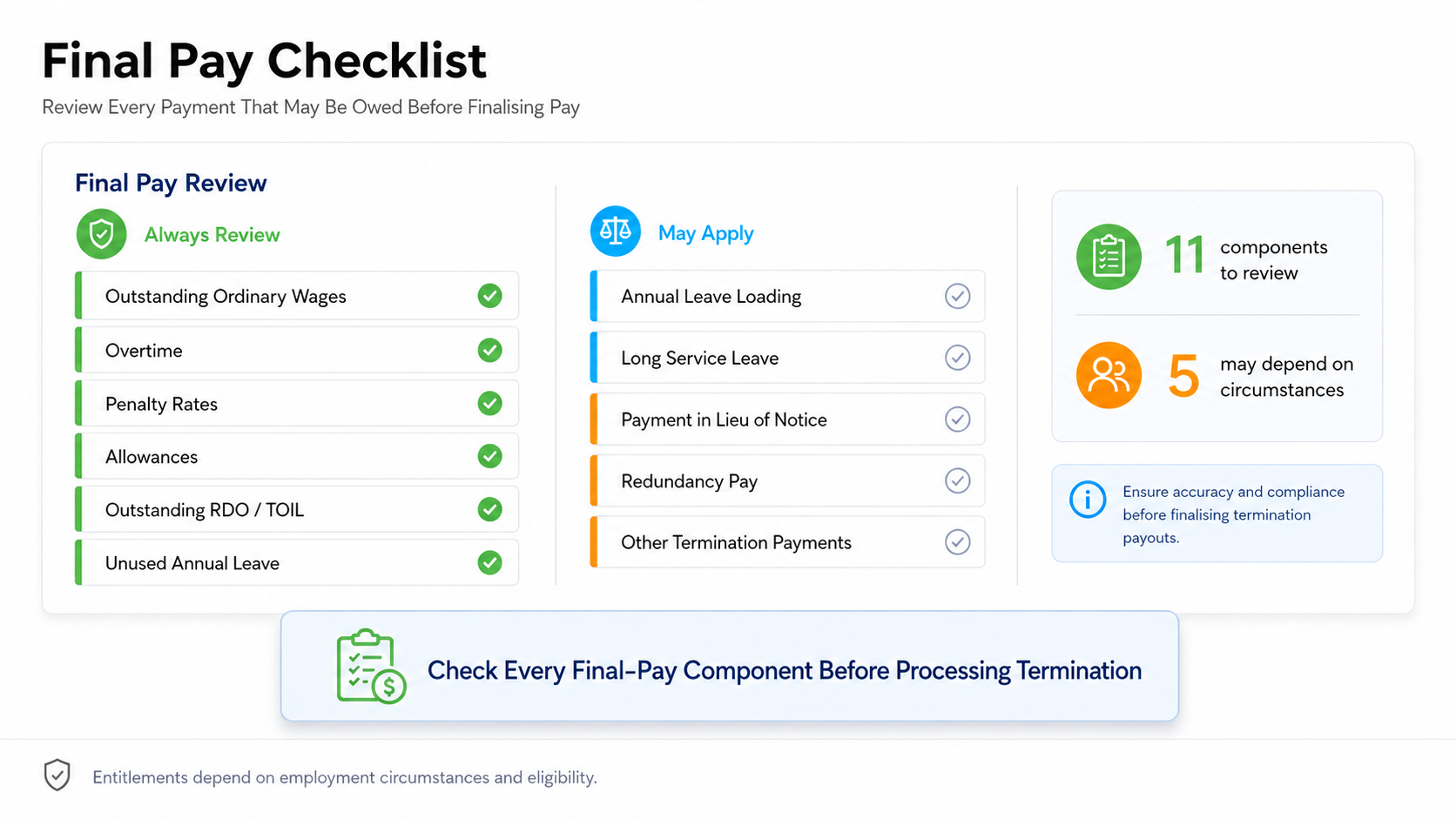
Final pay can include wages for hours already worked, penalty rates, allowances and unused annual leave. Depending on the circumstances, it can also include payment in lieu of notice, redundancy pay and accrued or pro-rata long service leave.
Before processing employee termination payroll, confirm:
- termination date
- termination reason
- full-time, part-time or casual status
- applicable modern award
- applicable enterprise agreement
- employment contract
- length of continuous service
- current leave balances
- outstanding timesheets
- RDO or TOIL balances
- ordinary working hours.
Why Does the Reason for Termination Matter to Payroll?
Employee termination reasons matter because resignation, dismissal, redundancy, retirement and other cessation types do not always produce the same payroll outcome. Notice requirements, redundancy entitlements, tax treatment and STP cessation reporting can all depend on why employment ended.
STP reporting also requires a cessation reason when an employee leaves. The ATO's cessation categories distinguish circumstances such as voluntary cessation, dismissal, redundancy, illness, deceased employees and the end of a contract.
▶What Is the Difference Between Resignation, Dismissal and Redundancy?
Termination payroll for a resignation normally focuses on outstanding wages, leave and any other accrued entitlements. Employer notice or redundancy payments will generally not apply in the same way as an employer-initiated termination.
Termination payroll for a dismissal may require employer notice or payment in lieu of notice unless an exclusion applies. Under the NES, casuals and employees dismissed for serious misconduct are among the employees excluded from the standard employer notice requirement.
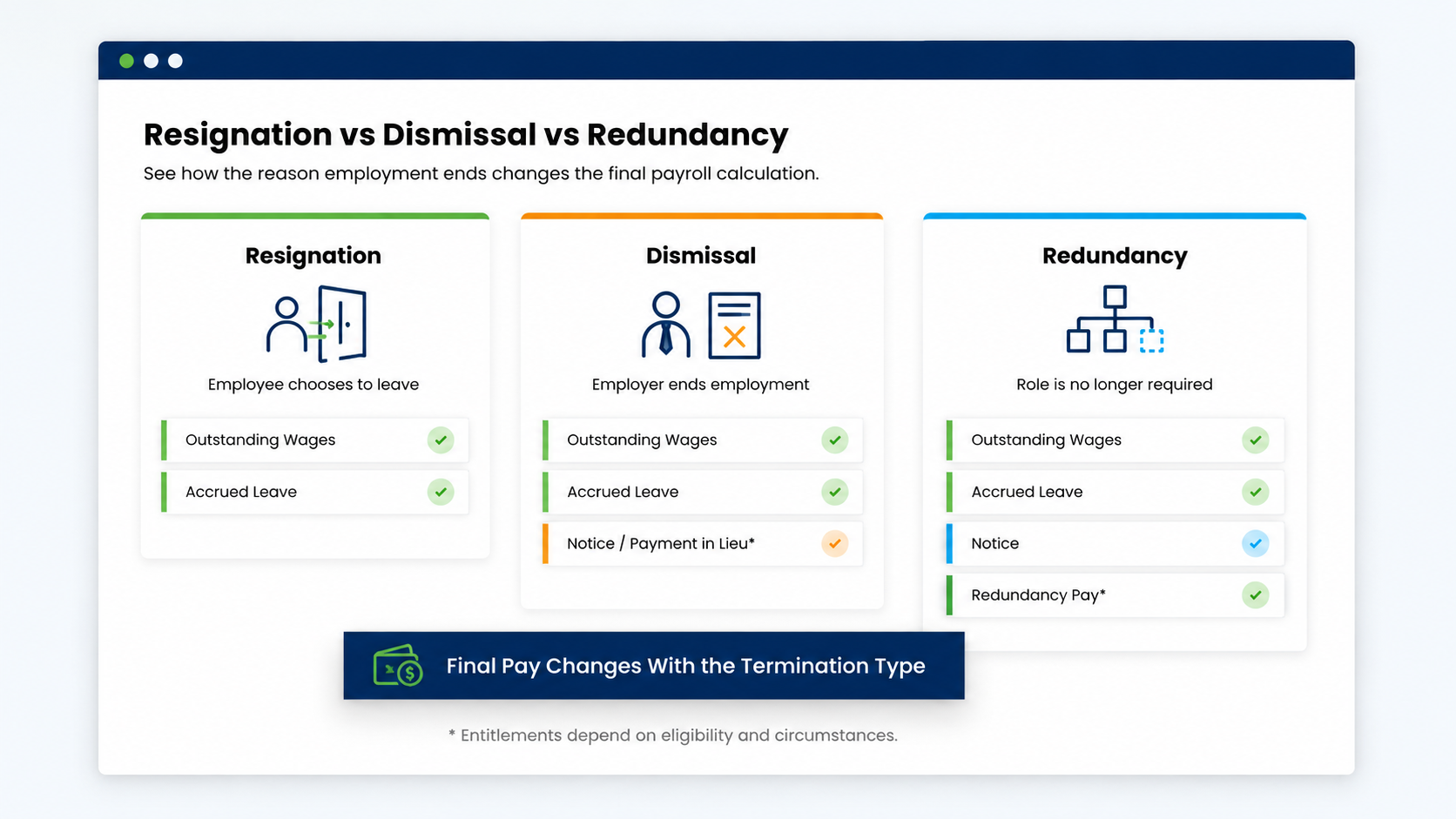
Redundancy payroll adds another layer because eligible employees may be entitled to redundancy pay as well as notice and their other outstanding entitlements. A redundancy generally occurs when the employer no longer requires the employee's job to be performed by anyone.
| Payroll issue | Resignation | Dismissal | Redundancy |
|---|---|---|---|
| Outstanding wages | Yes | Yes | Yes |
| Unused annual leave | Usually | Usually | Usually |
| Employer notice | Generally no | May apply | Usually applies |
| Payment in lieu | Usually no | May apply | May apply |
| Redundancy pay | No | No | Potentially |
| Long service leave | Check rules | Check rules | Check rules |
| STP cessation reporting | Yes | Yes | Yes |
| Tax treatment | Check payment types | Check payment types | Check carefully |
Why Should You Check the Award or Enterprise Agreement Before Final Pay?
Final pay obligations can come from the NES, modern awards, enterprise agreements and the Fair Work Act. Awards and agreements can also contain specific requirements for final-pay timing, RDOs, accumulated time off and other employment conditions.
Payroll compliance therefore should not rely on the NES alone. An employee's award or enterprise agreement may contain provisions that change the practical calculation or timing of amounts due when employment ends.
Award interpretation software can reduce the manual work involved in determining ordinary hours, overtime, penalties and allowances before the final payroll is prepared. Employers still need to confirm the correct industrial instrument and termination circumstances.
What Must Be Included in an Employee's Final Pay?
Final pay must include wages owed for work already performed and unused annual leave. Penalty rates and allowances already earned also form part of wages owing. Notice, redundancy and long service leave can apply depending on the employee's circumstances.
▶How Should Different Final-Pay Components Be Checked?
Final pay components should be assessed individually because the payroll treatment can differ across entitlement, tax, STP and superannuation. An amount being paid in the final payroll does not automatically make it an ETP or make it subject to the same super rules.
| Payment | When it applies | Payroll check | Tax/STP check | Super check |
|---|---|---|---|---|
| Ordinary wages | Hours already worked | Hours, rate, penalties, allowances | Report as normal earnings | Check qualifying earnings |
| Unused annual leave | Accrued leave remains | Balance and leave loading | Termination leave treatment | Generally not qualifying earnings |
| Long service leave | Entitlement exists | Jurisdiction and service | Termination leave treatment | Generally not qualifying earnings |
| Payment in lieu | Notice not worked | Full-rate calculation | ETP treatment may apply | Qualifying earnings |
| Redundancy | Eligible redundancy | Service and base rate | Tax treatment varies | Check payment component |
| Other ETP | Payment arises from termination | Correct category | ETP reporting | Check classification |
How Is Unused Annual Leave Paid on Termination?
Unused annual leave must be paid when employment ends. The employee must receive the amount they would have received if they had taken the leave during employment.
Annual leave loading must also be included where the employee would ordinarily receive leave loading when taking annual leave. Fair Work states that annual leave loading is payable on termination even where an award, agreement or employment contract says otherwise.
▶What Does an Annual Leave Termination Calculation Look Like?
Final pay calculations should start with the employee's confirmed leave balance and the rate that applies to that leave. For example:
| Item | Example |
|---|---|
| Unused annual leave | 76 hours |
| Ordinary hourly rate | $32.00 |
| Base leave value | $2,432 |
| Applicable leave loading | Calculate separately |
| Final leave payment | Leave value + applicable loading |
This final pay example is illustrative only. The applicable award, enterprise agreement and employee circumstances should be checked before calculating the actual payment.
Is Long Service Leave Paid When Employment Ends?
Long service leave can be payable when employment ends, but there is no single national calculation that works for every employee. Most employees derive their entitlement from state or territory long service leave legislation.
Pro-rata long service leave can also apply before the employee reaches the full service threshold. Eligibility can depend on the jurisdiction, length of service and reason employment ended. Awards, enterprise agreements and portable long service leave schemes can also affect the result.
▶What Should Employers Check for Long Service Leave?
Long service leave should be verified against the authority that applies where the employee works rather than copied from a generic national formula.
| Location | What to verify |
|---|---|
| ACT | Long service leave and portable scheme requirements |
| NSW | Long service leave entitlement and pro-rata termination rules |
| NT | Long service leave entitlement and termination rules |
| Queensland | Long service leave and relevant portable schemes |
| South Australia | Long service leave and portable scheme requirements |
| Tasmania | Long service leave and relevant portable schemes |
| Victoria | Long service leave and portable scheme requirements |
| Western Australia | Long service leave entitlement and termination rules |
Fair Work notes that portable long service leave schemes also operate in industries such as construction, contract cleaning, community services and security.
```What Happens to RDOs and Time Off in Lieu?
Final pay may need to include outstanding RDO or time-off-in-lieu balances where the applicable award or enterprise agreement requires payment. These balances should be reconciled before the employee's payroll record is closed.
Termination payroll errors can occur when the final calculation starts with leave balances but ignores outstanding timesheet-based entitlements. Checking approved hours, overtime arrangements and accruals before the final pay run reduces that risk.
How Much Notice Must an Employer Give an Employee?
Termination notice under the NES depends on the employee's continuous service. An employer must provide the minimum notice period or pay the employee instead of requiring them to work that notice.
| Continuous service | Minimum notice |
|---|---|
| 1 year or less | 1 week |
| More than 1 year to 3 years | 2 weeks |
| More than 3 years to 5 years | 3 weeks |
| More than 5 years | 4 weeks |
Employees aged over 45 who have completed at least two years of service when notice is given receive an additional week under the NES.
Termination notice does not apply under the standard NES rule to some employees, including casuals, certain fixed-term or seasonal employees and employees dismissed because of serious misconduct. Awards or agreements can require additional checking.
How Does Payment in Lieu of Notice Work?
Payment in lieu of notice allows an employer to end employment without requiring the employee to work some or all of the notice period. The payment must reflect the employee's full rate of pay for the minimum notice period.
Full-rate notice pay can include incentive-based payments and bonuses, loadings, monetary allowances, overtime or penalty rates and other separately identifiable amounts that would have applied. It is not necessarily the same calculation as the employee's base weekly rate.
Payment in lieu also has an earlier deadline than many other final-pay components. Where the NES requirement applies, the payment must be made before or on the employee's termination date.
When Is an Employee Entitled to Redundancy Pay?
Redundancy pay can apply where the employee's job is no longer required to be performed by anyone and the employee meets the relevant eligibility requirements. Under the NES, eligible employees generally need at least one year of continuous service.
Redundancy pay under the NES is calculated using the employee's base rate for ordinary hours. Incentives, bonuses, loadings, monetary allowances, overtime and penalty rates are not included in that base-rate calculation.
▶What Is the Current NES Redundancy Pay Scale?
Redundancy payroll under the NES uses the following minimum scale for eligible employees of non-small-business employers.
| Continuous service | Redundancy pay |
|---|---|
| At least 1 year but less than 2 years | 4 weeks |
| At least 2 years but less than 3 years | 6 weeks |
| At least 3 years but less than 4 years | 7 weeks |
| At least 4 years but less than 5 years | 8 weeks |
| At least 5 years but less than 6 years | 10 weeks |
| At least 6 years but less than 7 years | 11 weeks |
| At least 7 years but less than 8 years | 13 weeks |
| At least 8 years but less than 9 years | 14 weeks |
| At least 9 years but less than 10 years | 16 weeks |
| At least 10 years | 12 weeks |
The reduction from 16 weeks to 12 weeks once an employee reaches at least 10 years of service is part of the NES redundancy scale.
Does the Small Business Redundancy Exemption Always Apply?
Small business redundancy exemptions should not be reduced to "fewer than 15 employees means no redundancy". Under the Fair Work definition, a small business employer generally employs fewer than 15 employees when notice is given, but the counting rules matter.
Employee counting includes the employees being dismissed. Regular and systematic casuals can count, and associated entities are considered together. Special circumstances can also apply where a larger employer downsizes into the small-business category.
Award and enterprise agreement redundancy provisions must also be checked. Some industries have specific redundancy rules that can operate differently from the standard NES position.
How Long Does an Employer Have to Pay Final Pay in Australia?
Final pay does not have one universal Australian deadline. Employers must check the applicable award, enterprise agreement, NES requirements and Fair Work Act rules before deciding when payment is due.
Most awards require final pay within seven days after the employee's last day. Where an NES entitlement must be paid sooner, however, the NES timing takes priority. Payment in lieu of notice is one important example.
Use this final pay timing process:
- Identify the applicable award or enterprise agreement.
- Check its termination and final-pay clause.
- Identify any NES amount due earlier.
- Confirm the required payment date.
- Schedule the final payroll.
- Keep evidence of the calculation and payment.
Is Every Final Payment an Employment Termination Payment?
An Employment Termination Payment is a specific tax category, not another name for everything included in final pay. Ordinary wages, unused annual leave and unused long service leave are not automatically treated as ETPs simply because they are paid when employment ends.
ETP treatment can apply to payments such as payment in lieu of notice, certain severance payments, gratuities and taxable components associated with some redundancies. The exact category affects withholding and reporting.
An ETP generally needs to be paid within 12 months of termination to receive ETP treatment, subject to exceptions. Employers should use current ATO guidance rather than applying ordinary wage tax treatment to every termination amount.
▶How Are Common Termination Payments Treated for Tax?
Termination tax treatment should be applied by payment type rather than to the total final-pay amount.
| Payment | Ordinary wages? | ETP? | Separate termination tax treatment? |
|---|---|---|---|
| Final ordinary wages | Yes | No | Generally no |
| Unused annual leave | No | No | Yes |
| Unused long service leave | No | No | Yes |
| Payment in lieu of notice | No | Generally an ETP | Yes |
| Genuine redundancy | Depends on component | Depends on component | Yes |
How Is Unused Leave Taxed When Employment Ends?
Unused leave has its own termination withholding rules. The ATO's Schedule 7 covers unused annual leave, leave loading, leave bonuses and long service leave paid when employment ends.
Termination payroll therefore should not simply add unused leave to ordinary salary and apply the normal payroll treatment. The reason for termination, accrual period and type of leave can affect the applicable withholding treatment.
What Must Be Reported Through STP When an Employee Leaves?
STP Phase 2 reporting requires employers to include an employee's cessation date and cessation reason when the employee leaves. Final payment amounts must also be reported using the appropriate STP classifications.
Unused leave paid on termination is reported as the STP paid leave type "Unused leave on termination", rather than simply being combined with ordinary earnings.
Termination payroll involving an ETP also requires the relevant ETP information to be reported. The ATO requires an ETP to be reported in a pay event on or before the day the payment is made.
When Should an Employee Be Finalised in STP?
STP finalisation should occur after the employer is satisfied that the employee's termination calculations and year-to-date values are correct. Finalising too early can create extra correction work if another adjustment still needs to be processed.
Use this STP termination sequence:
- Confirm the cessation date and reason.
- Complete outstanding timesheet adjustments.
- Calculate final-pay components.
- Confirm the tax treatment.
- Process the final payment.
- Report the correct STP classifications.
- Review year-to-date values.
- Finalise once no further adjustments are expected.
Does Super Apply to Termination Payments Under Payday Super?
Payday Super applies from 1 July 2026, so employers now need to consider qualifying earnings as part of each termination payroll. For qualifying amounts, the employee's super fund generally needs to receive the contribution within seven business days after payday.
Termination payments should not have super calculated across the entire final-pay total. Each component needs to be assessed against the ATO's qualifying earnings rules.
▶Which Termination Payments Attract Super?
Payday Super qualifying earnings include payment in lieu of notice. By contrast, unused leave paid on termination, including unused annual leave, is excluded from qualifying earnings.
| Final-pay component | Qualifying earnings? | Employer action |
|---|---|---|
| Ordinary qualifying wages | Yes | Calculate SG |
| Payment in lieu of notice | Yes | Calculate SG |
| Unused annual leave on termination | No | Do not include solely as qualifying earnings |
| Unused long service leave on termination | No | Do not include solely as qualifying earnings |
| Other redundancy or ETP amounts | Depends | Check classification |
Termination super calculations should use current ATO qualifying earnings guidance whenever the treatment of a payment is uncertain. The label "termination payment" alone does not tell you whether SG is required.
What Records Should Be Kept After an Employee Leaves?
Termination payroll records should preserve enough information to show how the employee's final payment was calculated and why each component was treated the way it was.
Employers must keep time and wage records for seven years. Fair Work termination records must also identify how employment ended, whether notice was provided and, where relevant, how much notice was given and who terminated the employment.
Keep these termination payroll records together where possible:
- final approved timesheets
- pay rates and classification
- award or enterprise agreement
- termination date
- termination reason
- notice calculation
- leave balances
- RDO or TOIL balances
- redundancy calculation
- long service leave calculation
- PAYG withholding calculation
- ETP classifications
- STP submission
- super calculation and payment
- final payslip
- relevant HR documentation.
Employee Termination Payroll Checklist
Termination payroll is easier to control when employers complete the same checks in a consistent order.
Use this checklist before completing the final pay run:
Employee Termination Payroll Checklist
Termination date confirmedTermination reason confirmed
Employment type confirmed
Award checked
Enterprise agreement checked
Employment contract checked
Final timesheets approved
Ordinary wages checked
Overtime and penalties checked
Allowances checked
Annual leave balance checked
Annual leave loading checked
Long service leave checked
RDO and TOIL checked
Notice entitlement calculated
Redundancy entitlement checked
Final-pay deadline confirmed
Tax treatment confirmed
ETP treatment confirmed
Super treatment confirmed
STP cessation information prepared
Final YTD values reviewed
Payroll records retained
What Are the Most Common Termination Payroll Mistakes?
Termination payroll mistakes often come from treating the employee's departure as one calculation rather than a collection of different payment types.
| Mistake | Why it matters | Employer check |
|---|---|---|
| Missing annual leave loading | Can underpay final leave | Check normal leave entitlement |
| Treating everything as an ETP | Tax reporting can be wrong | Classify each payment |
| Applying super to the entire final pay | Some amounts are excluded | Check qualifying earnings |
| Missing super on notice pay | Payment in lieu qualifies | Check SG separately |
| Missing RDO or TOIL | Final entitlements may be incomplete | Reconcile balances |
| Using wrong cessation reason | STP information may be wrong | Confirm why employment ended |
| Ignoring an enterprise agreement | Additional rules may apply | Check industrial instrument |
| Assuming small-business redundancy exemption | Counting and award rules matter | Verify eligibility |
| Paying final pay late | Timing rules may be breached | Confirm deadline |
| Finalising STP too early | Later corrections become harder | Review all YTD values |
| Using one national LSL rule | State rules differ | Check jurisdiction |
| Weak calculation records | Makes review harder | Retain audit trail |
How Do You Process an Employee Termination in ClockOn?
ClockOn termination payroll starts by recording the employee's finish date and cessation reason on their employee profile. The finish date tells the system which payroll period should contain the termination.
ClockOn also retains the employee's payroll information after their employment instance is finalised, allowing previous payroll information to remain available for future access and review.
▶How Do You Prepare an Employee for Termination in ClockOn?
ClockOn employee termination setup is completed from the employee's Termination/Notes area. The payroll user selects Terminate, enters the finish date, selects the cessation type and can record termination notes.
ClockOn cessation options include employee-initiated reasons such as voluntary cessation and health, plus employer-initiated reasons including redundancy, dismissal, contract completion and transfer. These categories support the cessation information required during payroll processing.
Suggested image: ClockOn employee Termination/Notes screen showing the Finish Date and Cessation Type fields.
▶Why Should You Check the Employee's Working Week First?
ClockOn termination calculations use the employee's Working Week for several important values. ClockOn recommends reviewing contracted hours before processing the termination because these hours can influence standard weekly pay, notice, redundancy, long service leave and termination tax calculations.
ClockOn can also use payroll reporting to help review average working hours where a long service leave calculation requires historical averages rather than a simple current weekly-hours figure.
Suggested image: ClockOn Working Week screen used to verify the employee's standard hours.
▶How Does ClockOn Identify a Pending Termination?
ClockOn payroll automatically shows when an employee has a pending termination whose finish date falls within the current payroll period. This keeps the termination inside the pay run where the employee's final payment needs to be processed.
The payroll user then selects Options > Termination to open the dedicated termination workflow.
Suggested image: Current payroll showing an employee with a pending termination.
▶What Does the ClockOn Termination Wizard Calculate?
ClockOn's termination wizard guides the payroll user through final-payment options including leave payouts, payment in lieu of notice, redundancy, termination tax calculations and additional ETP amounts.
ClockOn supports normal terminations, redundancy or early retirement, and termination because of death. The workflow is designed to allocate payments, calculate relevant tax treatment and submit termination information through STP.
This termination payroll workflow reduces the need to build the employee's entire final payment manually outside the payroll system. The employer still needs to confirm which entitlements legally apply, but the processing itself remains connected to the employee's payroll record.
Suggested image: ClockOn termination wizard showing leave, notice and termination payment options.
▶How Does ClockOn Handle Redundancy Payments?
ClockOn redundancy processing includes an additional wizard screen for entering the redundancy amounts payable to the employee. This keeps the redundancy calculation within the termination workflow rather than treating it as an unrelated manual adjustment.
The termination wizard also uses the employee's working-week information when determining standard weekly pay for redundancy and payment-in-lieu calculations, making accurate employee setup particularly important before the final payroll is processed.
 See: Processing Employee Terminations support documentation
▶Can You Correct a ClockOn Termination Before Payroll Is Finalised?
ClockOn termination processing can be rerun if a mistake is identified before the payroll is completed. Once the wizard has finished, the payroll displays the termination as completed, but the wizard remains available for correction before the pay run itself is finalised.
That termination payroll checkpoint gives payroll staff an opportunity to review the result before locking in the final transaction.
How Can Payroll Software Reduce Termination Errors?
Payroll software reduces termination risk by keeping more of the underlying information inside one workflow. Timesheets, leave balances, employee hours, award conditions, payroll calculations, STP data and payroll history do not need to be repeatedly recreated in separate systems.
Connected termination payroll is especially useful for employers with hourly or award-covered employees because errors can originate before the final calculation. An incorrect timesheet, missed allowance, outdated leave balance or wrong standard working week can flow directly into final pay if it is not identified first.
ClockOn connects the workflow from approved time and attendance through award interpretation, leave records, payroll calculations and STP reporting. Its termination wizard then provides a structured process for handling the employee's final payroll components.
Payroll software does not decide whether a dismissal is lawful or whether a particular entitlement applies in every circumstance. Its role is to give employers a more controlled way to execute the payroll calculation once the relevant employment obligations have been established.
What Should Employers Check Before Completing a Termination Pay Run?
Final pay should only be completed after the employer has confirmed the employee's hours, leave, industrial instrument, termination reason and applicable notice or redundancy requirements.
Termination payroll should then separate each payment into its correct payroll, tax, STP and super category rather than applying one treatment to the total amount.
The final payroll step is review. Check the employee's gross payment, PAYG withholding, super, leave payouts, ETP components, cessation information and year-to-date values before completing the pay run and finalising the employee.
For complex or unusual termination circumstances, employers should verify their obligations against current Fair Work, ATO, state or territory guidance and obtain professional advice where necessary.
Frequently Asked Questions About Termination Payroll
▶What Must Be Included in Final Pay When an Employee Leaves in Australia?
Final pay generally includes wages owed and unused annual leave, including applicable annual leave loading. Notice, redundancy and long service leave may also need to be included depending on the employee's circumstances.
▶How Long Does an Employer Have to Pay Final Pay in Australia?
Final pay does not have one universal deadline. Most awards require payment within seven days after the employee's last day, but awards, agreements, the NES and Fair Work Act requirements must be checked.
▶Is Annual Leave Loading Paid When an Employee Is Terminated?
Annual leave loading is paid on termination where the employee receives it when taking annual leave. Fair Work states it remains payable on termination even where an award, agreement or contract says otherwise.
▶Do Casual Employees Receive Termination Pay in Australia?
Casual employee final pay still includes amounts already owed, but casuals generally do not receive paid annual leave and are excluded from the standard NES employer notice requirement. Most casual employees are also excluded from NES redundancy pay.
▶Do Employers Pay Super on Unused Annual Leave at Termination?
Payday Super qualifying earnings do not include unused annual leave paid on termination. Employers should assess each final-pay component separately rather than applying super to the entire termination payment.
▶Is Super Payable on Payment in Lieu of Notice?
Payday Super qualifying earnings include payment in lieu of notice. Employers therefore need to include the qualifying notice payment when calculating the employee's SG obligation.
▶What Is the Difference Between Final Pay and an ETP?
Final pay is the total group of amounts an employee receives when employment ends. An ETP is a specific tax category that can apply to particular termination-related amounts, such as payment in lieu of notice, but does not automatically include unused annual leave or long service leave.
▶How Do You Finalise an Employee Through STP After Termination?
STP termination reporting requires the employee's cessation date and cessation reason plus correctly classified final payments. Employers should check final year-to-date values and outstanding adjustments before marking the employee's STP information as final.