
A pharmacist finishes a morning shift at one pharmacy, then drives across town to cover the afternoon at another.
Both stores have the same owner. They may carry the same branding. To the pharmacist, it can feel like one working day.
Payroll has a different question: which business employed them for each shift?
If both pharmacies operate under the same employing entity, that's one situation. If they sit under separate ABNs, it's another.
That distinction has become even more operationally important in 2026, with payday super and Pharmacy Award updates.
Same owner, different ABN: the short answer
Pharmacy stores owned by the same person or group are not necessarily the same employing entity. If stores operate under one employing entity, employees may work across locations while remaining in that employer's payroll. If the employee works for separate employing entities, payroll records and reporting need to remain associated with the appropriate employer.
Two stores can look like one business and still have two employers
Imagine a pharmacy group with two stores.
A pharmacist works from 8am to midday at Pharmacy A, then covers an afternoon shift at Pharmacy B.
Both pharmacies have the same owner. Customers may see the same branding. Management may think of them as part of one group.
There are still two very different payroll scenarios.
If Pharmacy A and Pharmacy B are locations operated by the same employing entity under the same ABN, the employee is moving between workplaces of the same employer.
If Pharmacy A and Pharmacy B are operated by different employing entities with separate ABNs, and the pharmacist is employed by both, the employee is working for two employers.
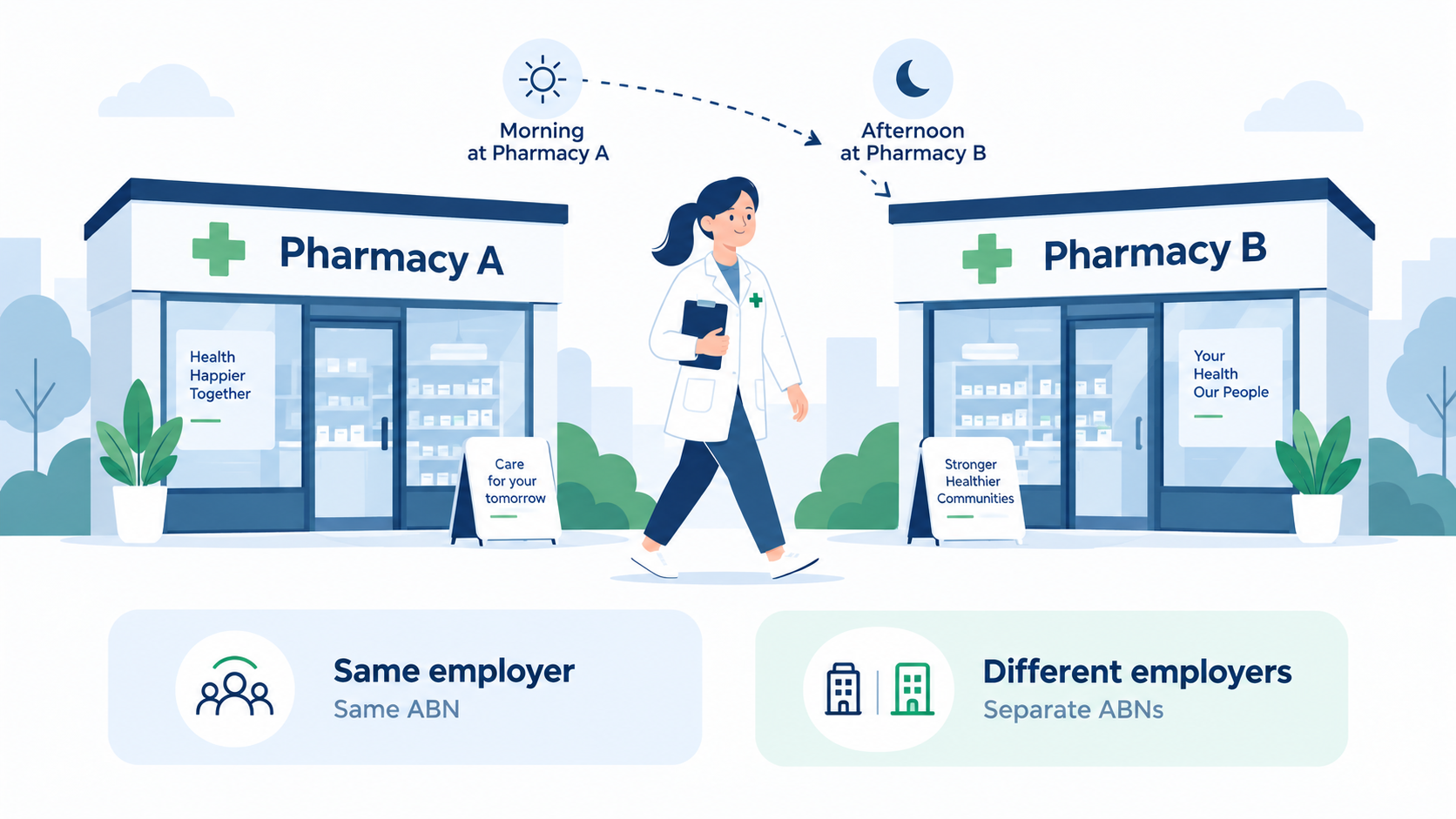
That distinction needs to survive the journey from roster to timesheet to payroll.
| Pharmacy structure | Typical payroll treatment | What the workforce system needs to preserve |
|---|---|---|
| Several pharmacies under one employing entity and ABN | Employee can remain within the same employer payroll while working across locations | Location, hours, role, approvals and labour costing |
| Pharmacies operated by separate employing entities and ABNs | Payments need to remain associated with the correct employer and payroll | Separate employer/payroll records, STP reporting and entity-level payment information |
| Same ABN using separate ATO branches | Reporting can still be separated by ABN and branch combination | Correct branch and STP reporting configuration |
The third scenario is worth noting. The ATO gives an example where an employee working for the same company ends up with two income statements because payments were reported under different ABN and branch combinations. Payroll identity can therefore be more specific than the business name a worker sees on the front door.
A pharmacy location and an employing entity are different things
This distinction sounds technical until payroll has to produce the records.
Fair Work requires employment records and pay slips to include the employer's name and ABN, where the employer has one. Pay records also need to show the amounts paid, deductions and separately identifiable entitlements such as penalties, allowances and loadings.
Single Touch Payroll has its own identifiers. The ATO uses information including the employer's ABN, branch and payroll identifiers to associate payroll reports with the correct payer and employee income statement.
So consider the pharmacist who works the morning for one company and the afternoon for another.
Operationally, it can feel like one working day.
Payroll has to know which employer is responsible for each set of hours.
Combining all eight hours into one entity simply because both pharmacies share an owner would lose that distinction.
Can the same pharmacist be on two payrolls?
Yes.
Australians can receive income from more than one payer at the same time. The ATO specifically provides for people with multiple jobs and employers, including rules around how the tax-free threshold is claimed when there is more than one payer.
For a pharmacy group, that means the same pharmacist can appear within the payroll of Pharmacy A Pty Ltd and Pharmacy B Pty Ltd where they genuinely have employment relationships with both.
Their identity does not change.
The employer paying and reporting those wages does.
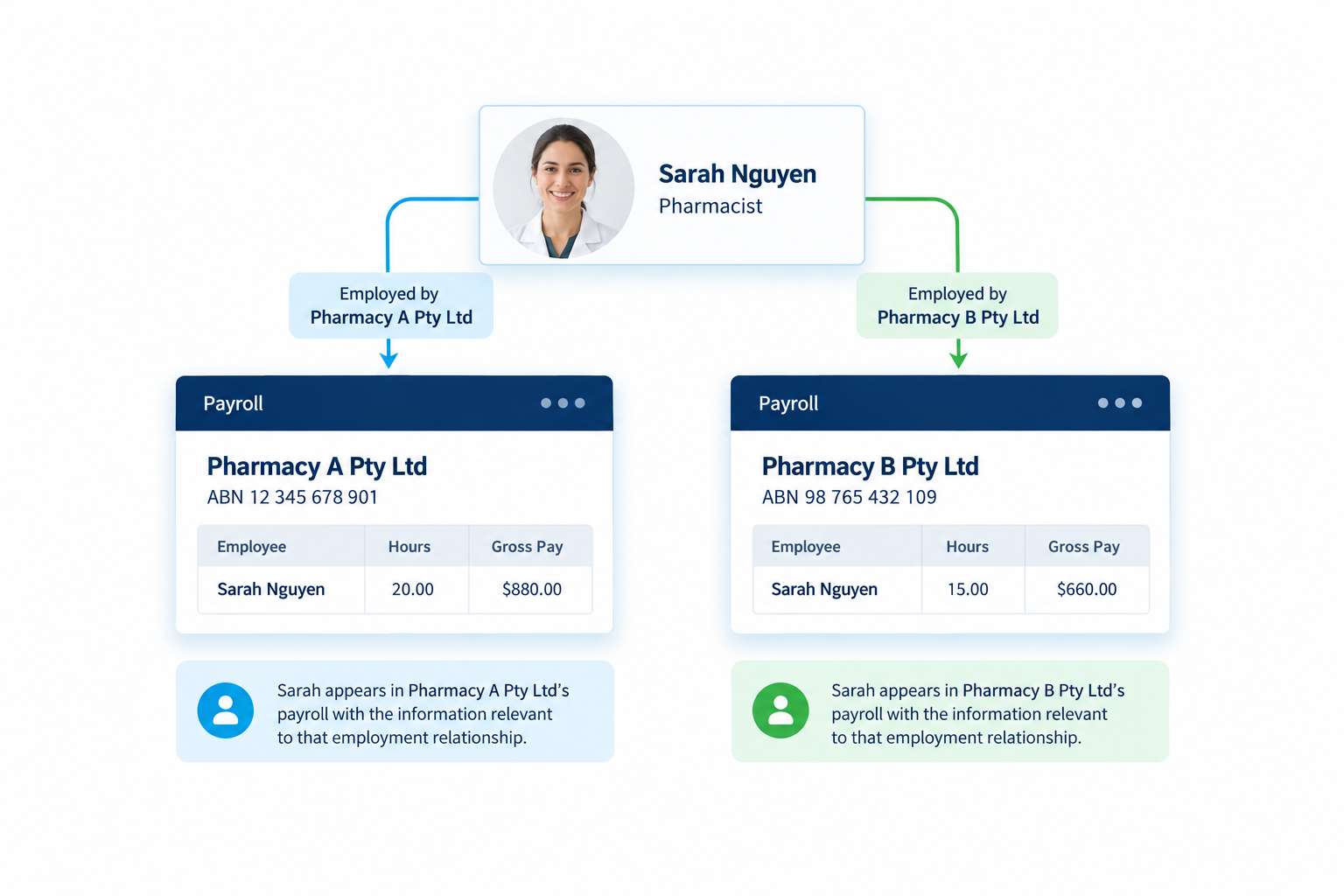
Each employer's payroll therefore needs to retain the information relevant to its employment relationship rather than merging both sets of wages into one group-level employee payroll.
Rostering across the group can still be coordinated
Separating employer payroll records does not mean pharmacy operations have to pretend the other stores do not exist.
A group still needs to know whether a pharmacist is available before offering them another shift. Managers may need visibility of people who can cover neighbouring locations. Head office may want to understand staffing across the network.
The important handoff comes when a shift becomes a payroll input.
If the employee works across several locations belonging to one employer, the system can keep the employment record consistent while attaching the shift, time and cost to the correct location.
When the shift belongs to a different employing entity, the approved hours need to reach that entity's payroll context.
That small distinction is where a seemingly simple shift swap can become a payroll problem.
ClockOn Online separates locations from ABNs deliberately
ClockOn Online's architecture provides a useful example of how these two structures can be treated differently.
Within a single ABN, ClockOn uses locations and departments to separate employees for rostering, payroll costing and reporting. Employees can be linked to locations and departments so the business can see where labour belongs without creating a new employing organisation simply because it operates another store.
The below walkthrough details the use of the Roster > Role mode and the adding of two shifts, where the employees are linked to the role, one in which the employee holds the required qualifications and another where they do not.
Where a customer manages separate businesses with different ABNs, ClockOn Online instead allows those businesses to be created as additional organisations within the same ClockOn account. Each organisation carries its own ABN and payroll settings.
That produces a simple structural model:
| Business reality | ClockOn Online structure |
|---|---|
| Another store under the same employing ABN | Location |
| Another department within that business | Department |
| Another employing business with a separate ABN | Organisation |
| Head office managing several employing businesses | Multiple organisations within the account |
Some long-term ClockOn customers may recognise that this differs from certain older ClockOn Desktop configurations, where employee information could be shared more flexibly across related entities.
ClockOn Online deliberately keeps organisations separated at the ABN level.
That structure more closely follows the way employer identity is carried through pay slips and STP reporting.
The 2026 payroll changes make the handoff more time-sensitive
Community pharmacy has had an unusually busy payroll year.
Pharmacists and interns covered by the Pharmacy Award received the second stage of the previously announced 14.1% increase from 30 June 2026. For affected employees, rates then increased again by 4.75% under the Annual Wage Review from the applicable pay period starting on or after 1 July.
Payday Super began on 1 July as well.
For a pharmacist working for two related pharmacy businesses, each employer needs the correct payroll information at the point it pays them. Super is now tied much more closely to that pay event rather than sitting as a separate quarterly process.
There is less room for the roster to say one thing while payroll has to work out later which company the shift belonged to.
A practical example
Consider a group with three community pharmacies.
Pharmacy Central Pty Ltd operates the Erina and Gosford stores under one ABN.
Pharmacy Coast Pty Ltd operates the Terrigal store under another ABN.
A pharmacist employed by Pharmacy Central normally works in Erina. On Wednesday they cover Gosford.
That remains work for Pharmacy Central. The location has changed, but the employer has not.
On Saturday, the pharmacist accepts a shift at Terrigal and is also employed by Pharmacy Coast for that work.
Now the employing entity has changed.
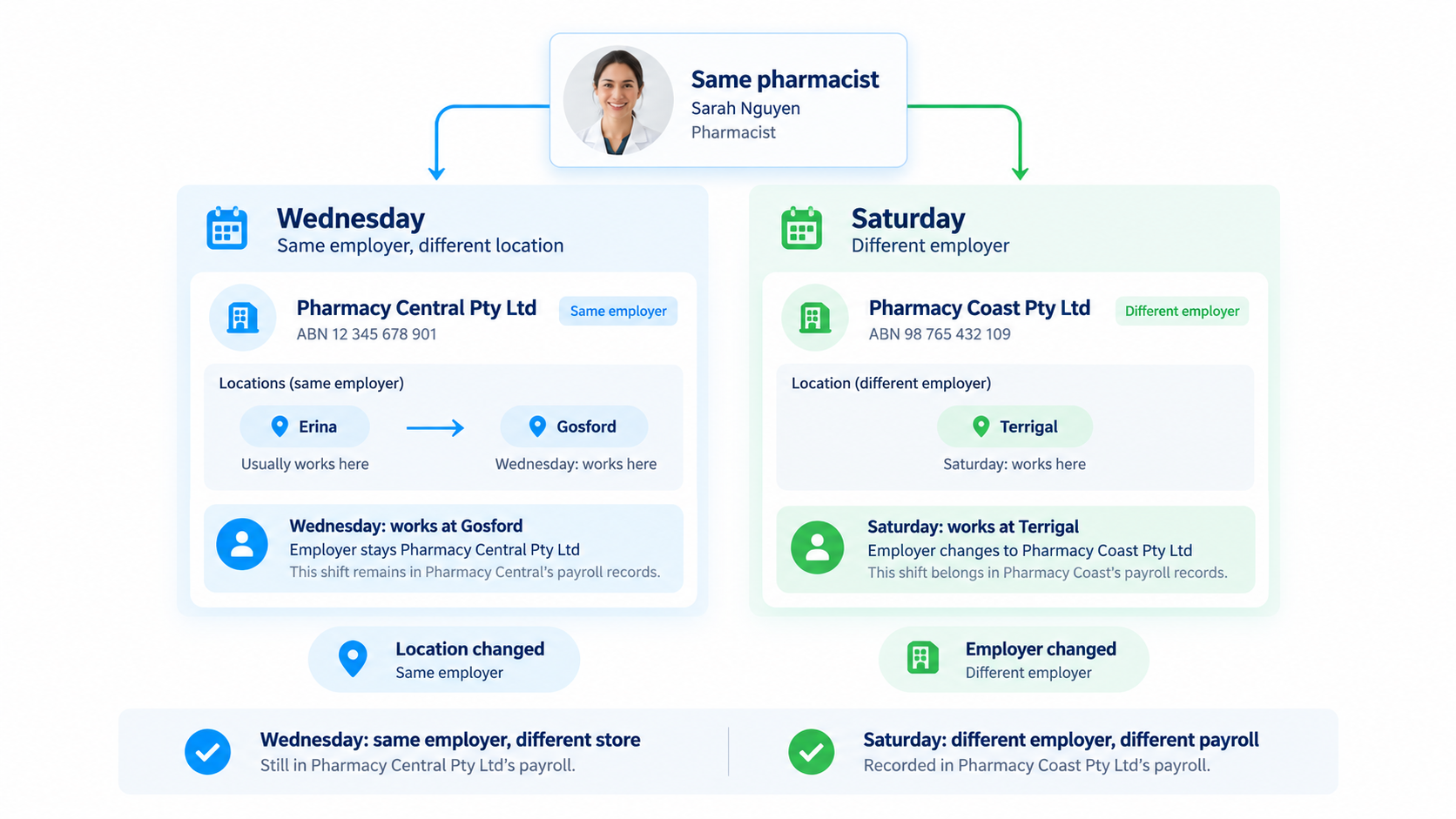
A workforce system should be able to tell those two situations apart.
Wednesday needs to retain Gosford as the relevant work location while remaining inside Pharmacy Central's employment and payroll structure.
Saturday needs to reach Pharmacy Coast's payroll records because that business is paying the pharmacist for that employment.
To the pharmacist, both shifts may feel like helping out elsewhere in the same pharmacy group.
To payroll, they are different events.
What about leave, entitlements and employee records?
This is an area where pharmacy groups should resist the temptation to make the software structure simpler than the employment structure.
A worker employed by two related companies should not automatically have every payroll balance blended together simply because the companies share ownership.
How service, leave and other entitlements are treated can depend on the employment arrangements and circumstances, including rules that may apply when employment transfers between associated entities.
Payroll software should preserve the underlying records. Questions about whether particular entitlements carry between employers should be checked against the applicable employment arrangements and current Fair Work requirements rather than solved by merging records.
Three questions to answer before the next cross-store shift
- Are the two pharmacies workplaces of the same employing entity, or do they sit under different employing businesses or ABNs?
- If the entities are different, which employer is employing and paying the worker for that particular shift?
- Can the roster, timesheet approval and payroll process retain that employer information without someone having to reconstruct it manually on pay day?
Those questions are more useful than simply asking whether a payroll product supports "multiple locations".
A system can handle ten stores under one ABN perfectly well and still be a poor fit for a group operating ten stores through several employing entities.
What pharmacy groups should test when comparing workforce software
Ask the software provider to demonstrate your actual structure rather than showing a generic roster.
| Question to test | What a useful demonstration should show |
|---|---|
| Can several stores sit under one employer? | Employees can work across relevant locations without losing location-level time and costing |
| Can the account contain several ABNs? | Separate employing organisations can be administered without combining their payroll obligations |
| What happens when one person works for two entities? | Payroll records remain attached to the correct employer |
| Can managers see only their pharmacies? | Permissions can reflect operational responsibility |
| Can hours be reported by store? | Worked time and labour costs retain location context |
| How do approved hours reach payroll? | The system preserves the location and employing organisation attached to the work |
| Can head office oversee the whole group? | Authorised users can manage the wider structure without collapsing the underlying entities |
ClockOn already treats these as separate use cases. Its guidance on multi-location workforce management covers staff moving between sites under the appropriate employment structure, while its guide to payroll processing across multiple companies and ABNs deals with the additional separation required between employing entities.
For pharmacies specifically, ClockOn's pharmacy workforce management solution combines rostering, time and attendance, configured award interpretation, payroll and HR. Cincotta Chemist describes using ClockOn across multiple locations and processing payroll through the system.
Can one pharmacy group use one workforce system across several ABNs?
It can, provided the system distinguishes central administration from the underlying employers.
That is the model ClockOn Online uses. Separate ABNs can be managed as separate organisations within the same account, while locations and departments remain available inside each organisation for operational separation, costing and reporting.
For a multi-pharmacy owner, that means you can still think about the workforce as a group.
Payroll does not have to pretend the group is a single employer when it isn't.
Start by drawing the structure of the pharmacies themselves: which stores belong to which employing entity, which ABN sits behind each one, and where staff genuinely work across those boundaries.
Once that map is clear, the right rostering and payroll setup becomes much easier to test.
Want to learn more about ClockOn for pharmacy workforce management?
Cincotta Chemist uses ClockOn across multiple locations and says the system allows it to process payroll “quickly and efficiently”.