
Payroll mistakes are much easier to prevent than unwind. ClockOn’s guide to running payroll in Australia shows where the pre-finalisation review fits into the wider pay-run process.
An incorrect pay rate, duplicated timesheet, outdated bank account or unexplained change in an employee's earnings can take minutes to catch before payroll is processed, and considerably longer to fix once the money has left the business.
That matters for more than administration. Payroll errors can lead to overpayments, underpayments, delayed wages, incorrect employee records and payroll compliance problems. In Australia, correcting an overpayment is not necessarily as simple as deducting the money from an employee’s next pay. The Fair Work Ombudsman’s guidance on overpayments explains that deductions to recover an overpayment are only permitted in limited circumstances.
So, what should you actually check before pressing Finalise?
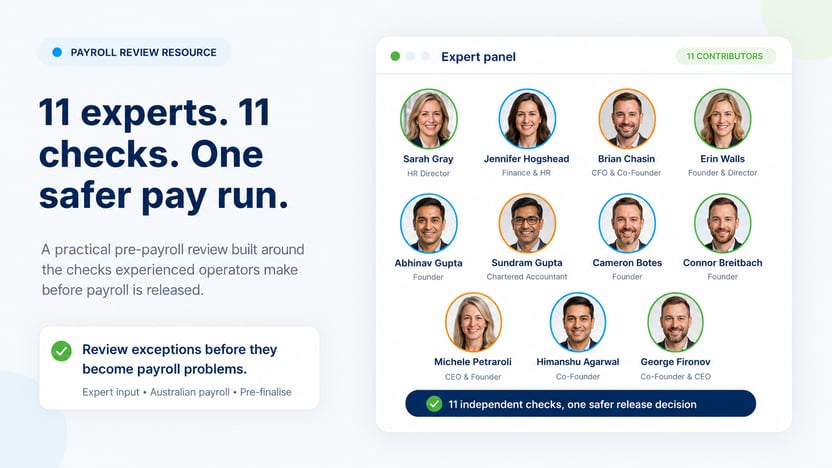
We asked 11 payroll, finance, HR and business professionals for the payroll check they would refuse to skip.
This guide combines their practical checks with an Australian pre-payroll review process you can use before every pay run.
Quick answer: Before finalising payroll, confirm who is being paid, reconcile changes against the previous run, verify timesheets and leave, review unusual pay movements, check employee details and bank information, confirm worker classifications, validate payroll funding and investigate every exception you cannot explain.
The 11-point pre-payroll checklist
- Reconcile the pay run against the previous period.
- Match leave taken against approved leave and balances.
- Confirm funds cover the complete payroll obligation.
- Recheck obligations affected by material earnings changes.
- Verify payment details and payroll authorisation.
- Check employee tax and account information.
- Look for duplicate employee and payment records.
- Investigate unusual movements in employee pay.
- Match paid hours against reliable time records.
- Confirm worker status still reflects the real arrangement.
- Match the final payroll against approved employee changes.
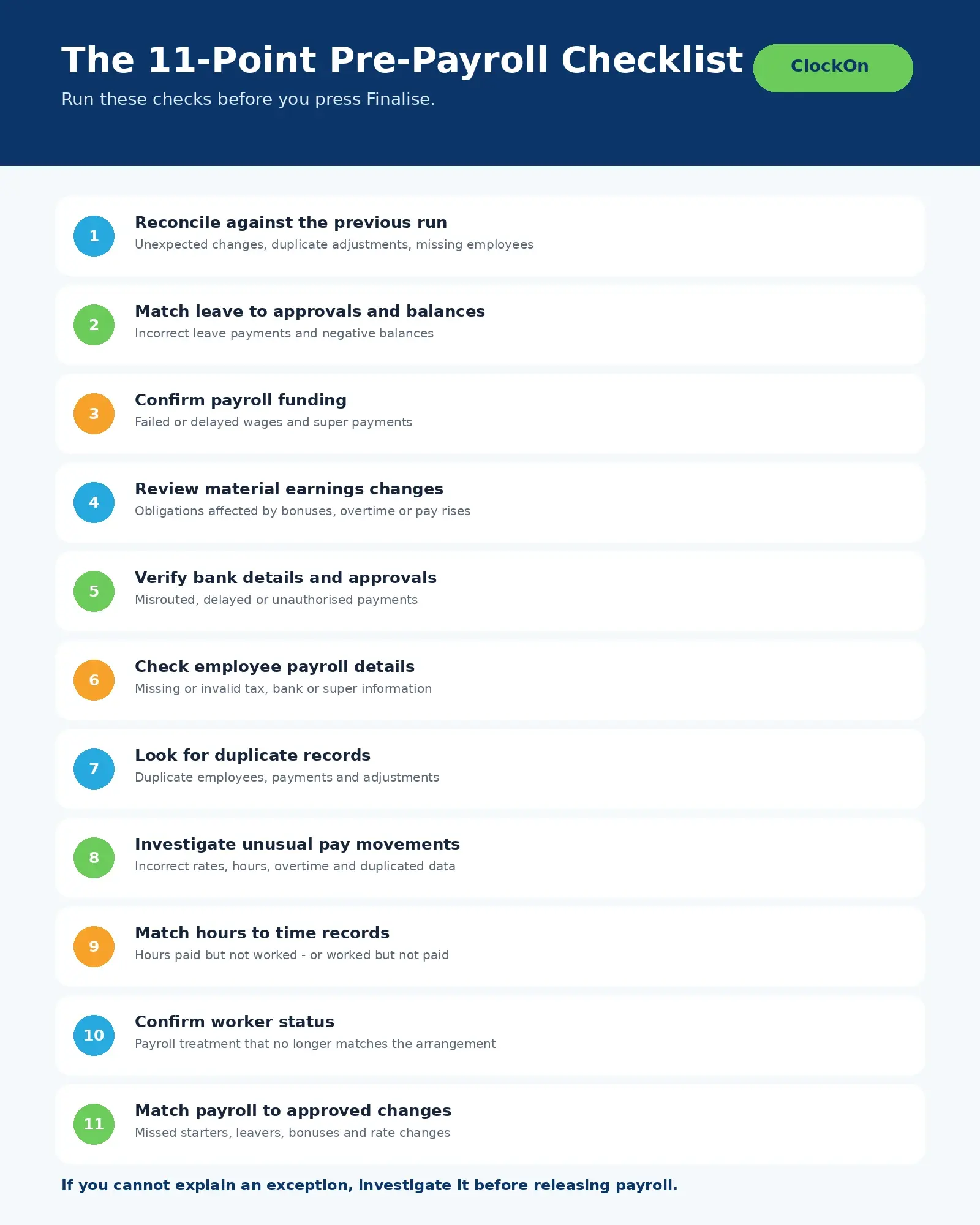
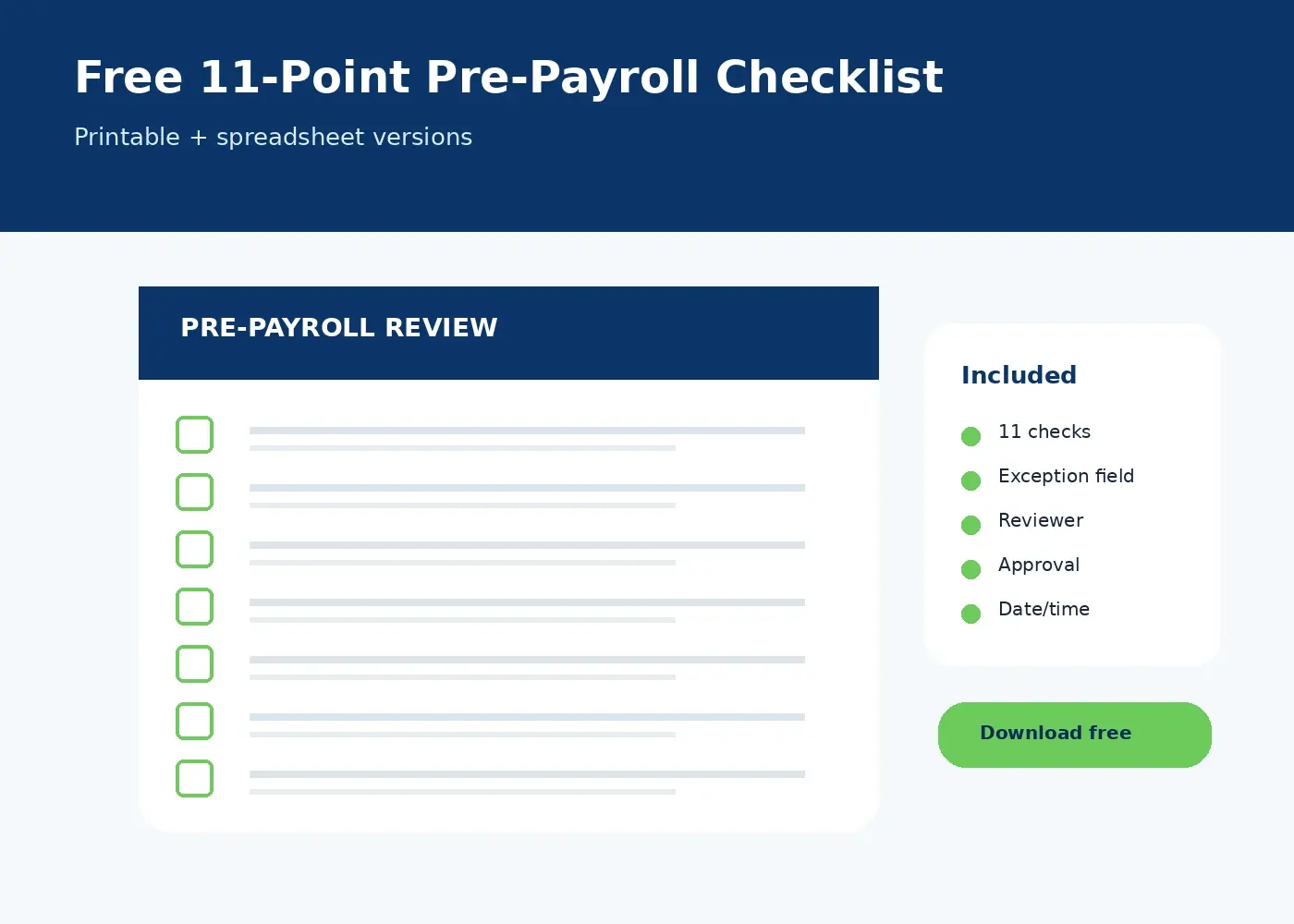
Free operational resource: Download the ClockOn 11-Point Pre-Payroll Checklist to use as a repeatable review and sign-off process.
The printable PDF is designed for quick pay-run reviews, while the editable spreadsheet includes fields for exceptions, resolutions, completion status and reviewer initials.
Download the PDF checklist Download the editable spreadsheet
1. Reconcile the pay run against the previous period
The check: Compare the current payroll with the previous pay run and account for every material movement.
A previous-period comparison is one of the quickest ways to find payroll changes that deserve investigation. It also feeds directly into useful payroll KPIs such as error rate, processing accuracy and on-time completion. Compare employee count, gross payroll, net payroll, starters, terminated employees, changed hours, bonuses, allowances, deductions, pay-rate changes and unusually large employee-level movements.
The objective is not to make every payroll identical. It is to make every difference explainable.

▶Expert perspective: Sarah Gray
HR Director, Cintra
Sarah Gray's non-negotiable check is a gross-to-net reconciliation against the previous payroll. Her team compares one pay period with the previous run and asks why the numbers have moved.
New starters, leavers, changed hours, bonuses and tax changes can all provide legitimate explanations. The problem is the movement that has no explanation.
Mistakes this check can catch: duplicate payments, unexplained adjustments, incorrect employee populations and changes entered twice.
2. Match leave taken against approved leave and balances
The check: Confirm that leave included in payroll agrees with approved leave records and the employee's applicable leave entitlement.
Before processing payroll, check that leave entered into payroll corresponds with the leave that was actually requested and approved, and that the employee record reflects the correct entitlement. The National Employment Standards set minimum employment entitlements, including several forms of leave.
A connected leave management process can reduce re-entry by keeping employee requests, manager approvals, balances and payroll records together.

▶Expert perspective: Jennifer Hogshead
Director of Finance and Human Resources, New Waters Recovery
Jennifer Hogshead recommends reconciling paid time off against accrued balances and approved leave before payroll is processed.
Her contribution comes from a US payroll context, where the terminology and rules differ from Australia's National Employment Standards and applicable awards or agreements.
The underlying control transfers well: the leave being paid should agree with both the approved absence and the employee's applicable leave record.
Mistakes this check can catch: incorrect leave entries, mismatched balances, unapproved leave and inaccurate final-pay calculations.
3. Confirm funds cover the complete payroll obligation
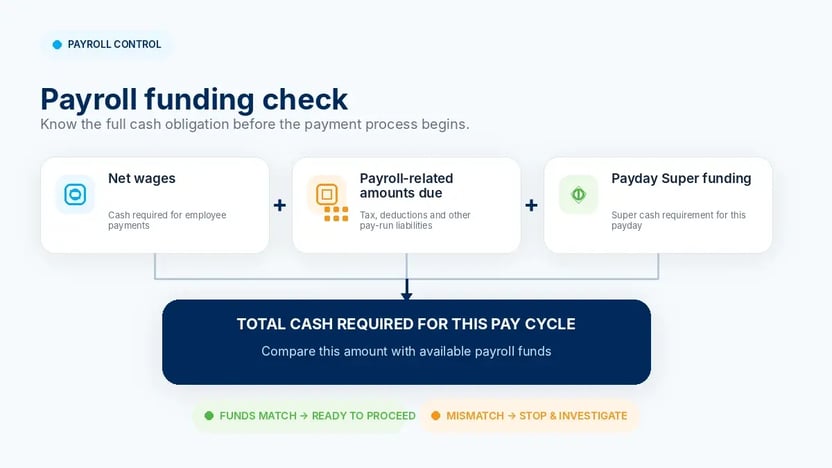
The check: Confirm that available funds are sufficient for the amounts the business needs to pay as part of the payroll cycle.
A correct payroll calculation is still a failed pay run if the payment cannot be completed. Funding should be considered alongside the wider Australian payroll sequence, including super obligations within each pay cycle; see ClockOn’s Australian payroll process guide. Before releasing payroll, reconcile the amount being funded with the amounts the business expects to pay.

▶Expert perspective: Brian Chasin
CFO & Co-Founder, SOBA New Jersey
Brian Chasin calls this a gross payroll liability funding reconciliation. His process is simple: before payroll is released, compare the organisation's payroll cash obligations with the liquid funds available for the transaction.
Brian works in the United States, so references in his original process to ACH transfers and US tax liabilities don't directly apply to Australian employers. The financial control does.
Mistakes this check can catch: inadequate payroll funding, failed transactions, delayed wages and cash-flow surprises.
4. Recheck obligations after a material earnings change
The check: Flag employees whose earnings have changed materially and confirm whether the change affects any payroll obligation, entitlement or treatment.
One-off bonuses, overtime, increased hours and pay rises don’t only change gross pay. For Australian employers, the risk increases where overtime, on-call and allowance payments need to be mapped correctly through payroll and STP. Depending on the employee and circumstances, they can change the way another payroll item needs to be treated.
Where earnings change because of overtime, penalties, allowances or other conditions, properly configured award interpretation can help apply established pay rules consistently. The resulting payroll should still be reviewed before finalisation.

▶Expert perspective: Erin Walls
Founder & Director, WallsMan Creative
Erin Walls uses this approach with UK payroll clients. Her specific example relates to the UK's workplace pension auto-enrolment thresholds, so those thresholds should not be applied to an Australian pay run.
The useful process is the exception logic behind Erin's recommendation:
Material earnings change → identify the employee → check whether anything else has changed as a consequence.
5. Verify bank details and payroll authorisation
The check: Confirm the employee payment details, payment-file totals and required payroll approvals before money is released.
For Australian businesses using an ABA file or another banking workflow, check the information generated for payment before authorising the transaction.
Changes to employee bank details deserve additional scrutiny, particularly when they were made shortly before the pay run.

▶Expert perspective: Abhinav Gupta
Founder, Profitjets
Abhinav Gupta recommends reconciling the banking details in the payroll export with the business's approved payroll banking information and confirming that the correct people have authorised the payment.
His contribution refers to account and routing numbers used in other banking systems. Australian payroll teams will generally work with BSB and account numbers instead.
Mistakes this check can catch: incorrect payment details, payment delays, unauthorised transactions and time-consuming reversals.
6. Check employee tax and account information
The check: Review missing, recently changed or obviously inconsistent employee details before finalising payroll.
Review employees where important information has recently changed, been newly added, failed validation, been left incomplete or been manually overridden.
Depending on the employee and payroll process, relevant information can include tax details, bank details, superannuation information and employment settings used by payroll. The ATO’s Single Touch Payroll guidance explains how employee tax and super information is reported through STP.

▶Expert perspective: Sundram Gupta
Founder & Chartered Accountant, Patron Accounting LLP
Sundram Gupta's original recommendation is to double-check PANs and bank information before payroll is processed. PANs are an Indian tax identifier, so they are not an Australian payroll requirement.
The useful principle for an Australian payroll team is to identify critical employee details that are missing or inconsistent before the pay run is released.
7. Look for duplicate employee and payment records
The check: Search for records that appear more than once before final approval.
Look for duplicate employees, payroll entries, allowances or adjustments, timesheet imports, bank accounts, termination entries and one-off payments. Where the exception involves a departing employee, use a dedicated termination payroll review.

▶Expert perspective: Cameron Botes
Founder, BizBud
Cameron Botes makes duplicate checking one of the final steps before approving every pay run.
He has seen issues including employees being added or terminated twice, termination details being configured incorrectly and payment accounts appearing against multiple employee records.
His rule is simple: don't make this a monthly or quarterly audit. Make it part of every pay run.
8. Investigate unusual movements in employee pay
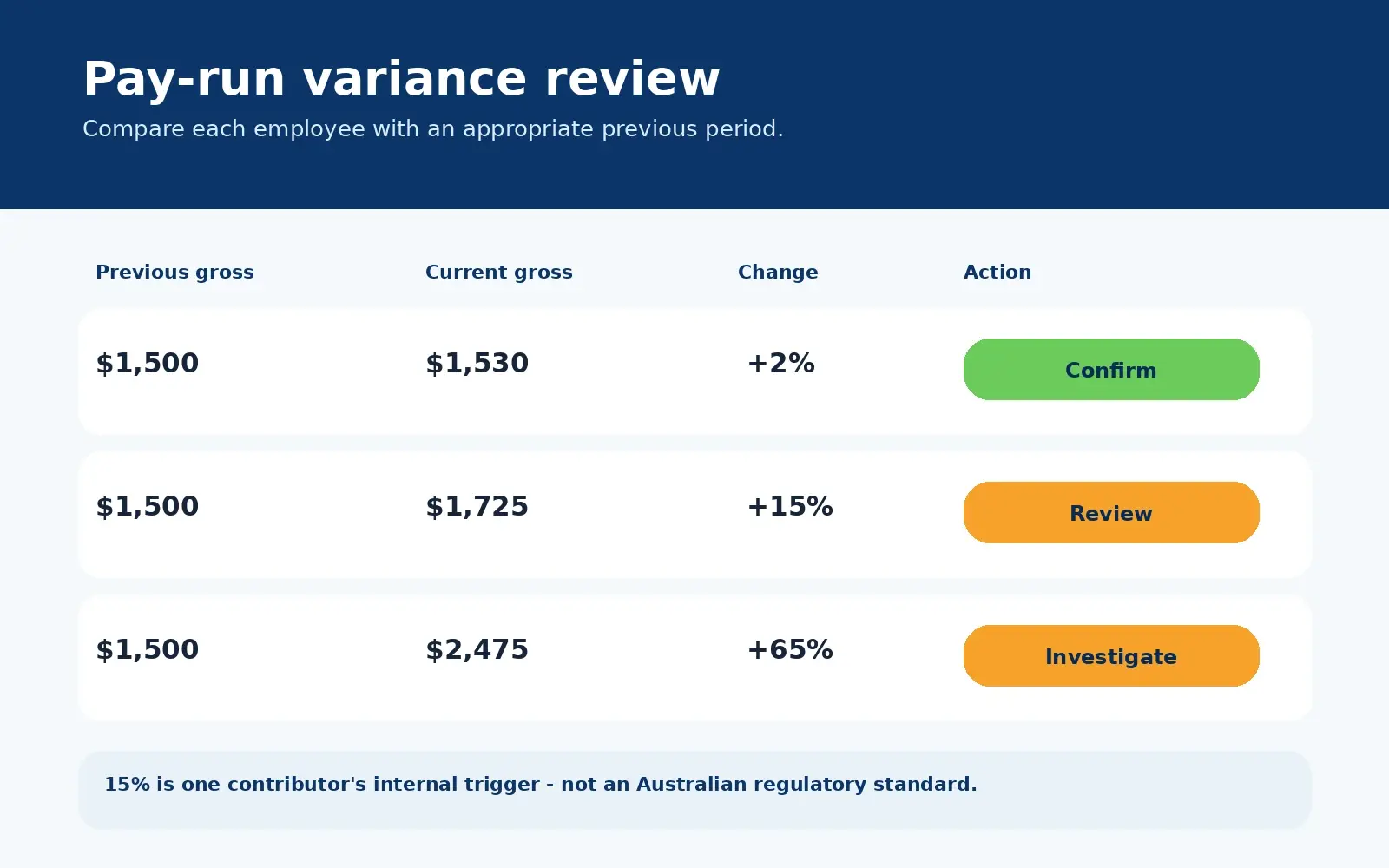
The check: Compare each employee's current pay with an appropriate previous period and investigate large unexplained differences.
Aggregate payroll can look normal while an individual employee’s pay is completely wrong. Employee-level variance checks therefore complement the broader payroll performance metrics used to monitor the whole process.

▶Expert perspective: Connor Breitbach
Founder, Ascent Surface Care
Connor Breitbach compares gross pay with the previous period and flags employee-level variances above 15% for investigation.
That 15% figure is Connor's operating threshold, not an Australian regulatory standard. The principle is more useful than the exact percentage.
Mistakes this check can catch: incorrect pay rates, duplicated hours, excessive overtime, duplicated imports and data-entry mistakes.
9. Match paid hours against reliable time records
The check: Compare the hours payroll is about to pay with reliable records of the time actually worked.
The goal is having sufficiently reliable evidence of when work occurred so payroll does not depend on somebody rebuilding the week from memory several days later. Fair Work’s record-keeping guidance says employers must keep time and wages records for seven years and recommends keeping records of hours worked for all employees.
Using time and attendance software can help capture actual clockings and surface differences between planned shifts, recorded attendance and the hours ultimately approved for payroll. See also ClockOn’s guide to reducing time and attendance errors before payroll.

▶Expert perspective: Michele Angelo Petraroli
CEO & Founder, GeoTapp
Michele Angelo Petraroli recommends putting the hours about to be paid alongside a record created when the work actually happened.
His reasoning comes from first-hand experience working in event security, where hours were recorded manually and later rebuilt into a spreadsheet.
For payroll, the broader principle is: use contemporaneous time records wherever practical, then investigate differences between those records and the hours entering payroll.
10. Confirm worker status still reflects the real arrangement
The check: Review whether the payroll treatment of a worker still reflects the legal and contractual arrangement actually in place.
Worker classification is not something to decide casually from a payroll screen. The ATO provides separate guidance on super for independent contractors, including situations where a contractor may be treated as an employee for super guarantee purposes. Payroll can, however, expose circumstances that deserve a proper review.

▶Expert perspective: Himanshu Agarwal
Co-Founder, Zenius
Himanshu Agarwal recommends checking whether the way a worker is paid remains consistent with the arrangement under which they are working.
The important Australian point is that payment by invoice does not, by itself, determine worker status. Payroll teams should flag suspicious inconsistencies for proper review rather than trying to make a legal classification from the pay run alone.
11. Match the final pay run against approved employee changes
The check: Confirm that every approved payroll change made it into the final run once, and only once.
Check new starters, terminations, pay rises, bonuses, hours changes, allowances, bank changes and employment changes against the authorised source. For leavers, ClockOn’s termination payroll checklist covers the additional final-pay review points.

▶Expert perspective: George Fironov
Co-Founder & CEO, Talmatic
George Fironov compares the previous payroll report and the current approved employee changes before releasing payroll.
He specifically checks new hires, departures, salary increases, bonuses and changed working hours against the source documents authorising those changes.
The final comparison asks one simple question:
Did everything we approved appear correctly in payroll?
The final 60-second payroll review
Before you press Finalise, answer these 11 questions:
- Can I explain the movement from the previous payroll?
- Does paid leave agree with the approved leave records?
- Are sufficient funds available for this payroll cycle?
- Have material employee earnings changes been reviewed?
- Have payment information and approvals been verified?
- Are critical employee payroll details complete?
- Are there any duplicate employees, payments or records?
- Can I explain unusual employee-level pay variances?
- Do paid hours agree with reliable time records?
- Are there worker-status issues requiring proper review?
- Does the payroll agree with every approved employee change?
Stop rule: If you cannot explain an exception, investigate it before releasing payroll.
Payroll software doesn't remove the need for payroll checks
Good payroll software automates calculations and repetitive processing. It does not eliminate the need for human review.
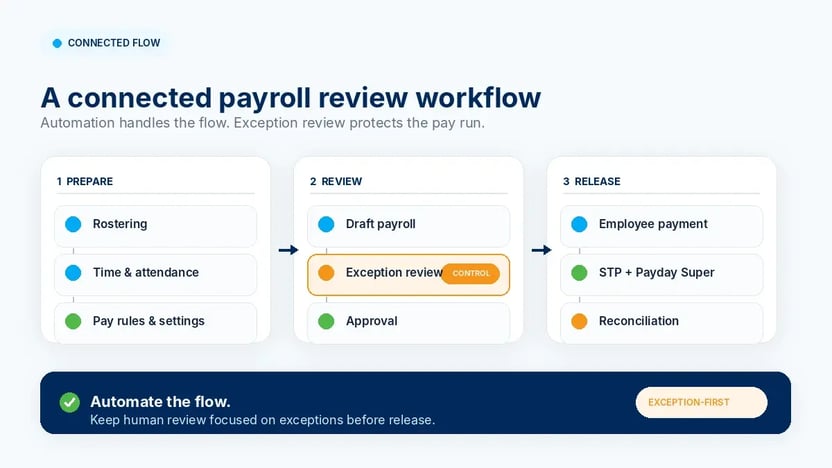
The strongest payroll workflow combines automation with exception-based review.
That means allowing repeatable calculations and data movement to happen efficiently while making unusual results, changed employee details and unexplained differences visible before money is released.
How ClockOn helps make payroll easier to review
ClockOn connects rostering, employee time and attendance, configured award and payroll rules and payroll processing so payroll teams can review the information behind a pay run before it is processed.
Connecting rostering, attendance, approved timesheets and payroll reduces the amount of information that has to be manually rebuilt between separate systems.
The objective isn't to remove payroll review. It's to make the pay run easier to explain before you approve it.
Make the pay run easier to verify before you press Finalise.
ClockOn brings rostering, time and attendance, award interpretation and payroll into one connected workflow.
Download the checklist 👇
Keep the checklist beside you for every pay run.
Use the downloadable version to record exceptions, resolutions and sign-off before payroll is released.
About this guide
This guide combines Australian payroll information with practical contributions from 11 payroll, finance, HR and business professionals working across several jurisdictions.
Where a contributor's original example relates to another country's payroll, tax, pension or banking system, the underlying operational lesson has been separated from Australian requirements.
Australian employers should apply the Fair Work Act, applicable awards or agreements, Fair Work record-keeping requirements, ATO Single Touch Payroll requirements and other obligations relevant to their own circumstances.
This article provides general information and is not legal, tax or industrial-relations advice.