
Navigating the complexities of payroll management requires precise indicators of success. This article demystifies the essential key performance indicators (KPIs) for payroll accuracy, efficiency and compliance, with insights from industry experts.
Discover practical strategies to track and improve your organisation's payroll performance.
Payroll KPIs for Payroll and HR Departments
Payroll KPIs covered in this guide:
▶On-Time Payroll Processing
Measures the consistency and punctuality of salary payments to employees.
- Target: 99.9%–100%
- Acceptable range: 98%–99.8%
- Warning level: Below 98%
Measurement: Percentage of payroll cycles completed by the designated payday.
Industry note: Many organisations aim for “perfect payroll”, meaning 100% on-time processing.
▶Payroll Error Rate
Assesses the frequency of errors in payroll calculations and payments.
- Excellent: Less than 1%
- Good: 1%–2%
- Needs improvement: 2%–3%
- Critical action required: More than 3%
- Industry best practice: Less than 0.5%
How to calculate: (Number of errors ÷ total payroll transactions) × 100
▶Overtime Pay as a Percentage of Payroll
Analyses the proportion of payroll expenses attributed to overtime compensation.
- Optimal: 5%–10%
- Acceptable: 10%–15%
- Review required: 15%–20%
- Critical review required: More than 20%
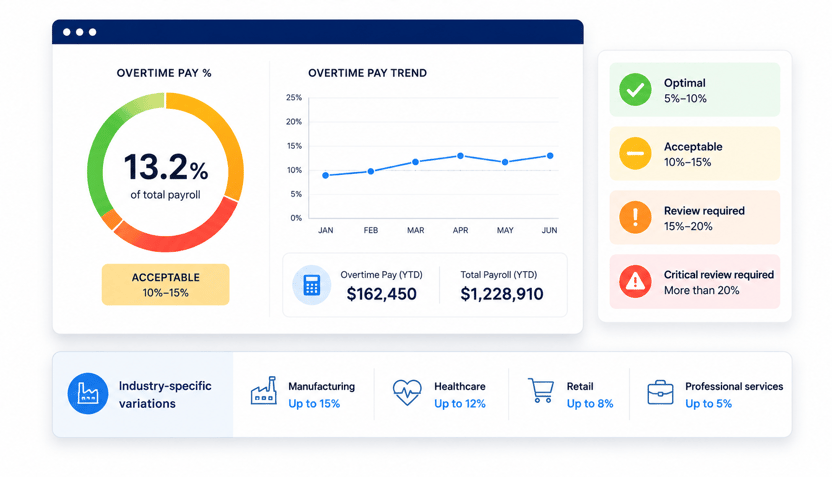
Industry-specific variations:
- Manufacturing: Up to 15%
- Healthcare: Up to 12%
- Retail: Up to 8%
- Professional services: Up to 5%
▶Payroll Processing Cost
Calculates the total cost involved in processing payroll, including administrative expenses.
- Excellent: Less than 0.85% of total payroll
- Good: 0.85%–1.5% of total payroll
- Average: 1.5%–2% of total payroll
- Needs improvement: More than 2% of total payroll
.jpg?width=559&height=559&name=ClockOn%20(15).jpg)
▶Employee Satisfaction with Payroll
Gauges employees’ satisfaction with the payroll process, often through surveys and complaint monitoring.
- Target: More than 90% satisfaction
- Good: 80%–90%
- Needs attention: 70%–80%
- Critical: Less than 70%
Measurement methods:
- Survey response rate target above 75%
- Complaint rate below 1% of employees per pay period
▶Compliance Rate
Monitors adherence to relevant payroll regulations and legal requirements.
- Target: More than 90%
- Good: 80%–90%
- Needs attention: 70%–80%
- Critical: Less than 70%
Measurement methods:
- Regular payroll compliance reviews
- Monitoring identified payroll breaches or discrepancies
- Tracking the completion of required corrections and remediation
Payroll KPIs set the foundation for performance, but real success comes from strategic application. Industry leaders have optimised payroll by tracking key metrics, leveraging automation and making data-driven adjustments to enhance accuracy, efficiency and compliance.
The following expert insights reveal how businesses reduce errors, streamline processing, maintain compliance and cut costs, offering actionable takeaways to improve any payroll strategy.
Recommendations and Insights from Business Leaders
Expert recommendations covered:
▶Track Payroll Error Rates to Improve Accuracy and Compliance
Payroll accuracy is more than a numbers game. It is a key factor in maintaining compliance and employee trust.
Tracking payroll error rates is one of the most effective ways to assess the efficiency of your payroll system and identify areas for improvement.
“Even small errors can have a major impact on employee satisfaction and compliance with tax regulations,” says Jason Rowe, Founder and Electrician at Hello Electrical.
His business closely monitors payroll errors to ensure accuracy. When a spike in overtime miscalculations occurred, the company took swift action.
By implementing payroll software that automatically tracks hours worked and training staff on time-tracking best practices, Hello Electrical reduced payroll errors by 30%.
The result was faster processing, fewer compliance risks and improved employee confidence in the payroll system.
For any business, tracking error rates is a crucial KPI that supports both efficiency and compliance. Reducing mistakes saves time, mitigates financial penalties and strengthens employee satisfaction.
▶Monitor Payroll Variance Percentage to Prevent Costly Surprises
Payroll may not be the most exciting aspect of business operations, but errors can quickly turn it into a costly problem.
One of the most effective KPIs to track is payroll variance percentage, which measures unexpected discrepancies between projected and actual payroll costs.
“Even a 1.5% variance can signal issues—misclassifications, tax miscalculations or even compliance risks,” says Thomas Franklin, CEO of Swapped.
To keep payroll variance under control, his company shifted from end-of-month reconciliations to weekly variance tracking. This led to a 60% reduction in payroll discrepancies within three months.
The proactive approach saved the company approximately $4,000 per quarter by preventing overpayments and penalties.
While payroll may never be flawless, reducing variance helps businesses avoid financial risks, improve forecasting and maintain compliance.
Keeping variance below 0.5% has been a significant improvement for Swapped, demonstrating how small process adjustments can produce meaningful financial results.
▶Ensure Payroll Accuracy to Improve Efficiency and Compliance
Payroll accuracy is not only about paying employees on time. It is essential for compliance and operational efficiency.
Tracking payroll accuracy rates helps ensure payments are processed correctly the first time, preventing delays, tax reporting issues and time-consuming corrections.
“In digital marketing, where we work with both full-time employees and contractors, even a small miscalculation in 401(k) contributions or tax withholding can lead to compliance headaches,” says Sean Clancy, Managing Director of SEO Gold Coast.
To minimise errors, his company integrated payroll software that automatically cross-checks pay rates, tax deductions and contributions before payments are finalised.
Payroll accuracy has remained above 99%, processing time has been cut in half and compliance has improved through more precise tax and benefit calculations.
By reducing manual errors and reconciliation work, businesses can process payroll more smoothly while meeting regulatory obligations without last-minute adjustments.
▶Reduce Payroll Processing Time for Smoother Operations and Higher Morale
In industries with seasonal demand and a mix of employees and subcontractors, efficient payroll processing is critical for maintaining workforce satisfaction and compliance.
Payroll delays can create frustration and may lead to costly penalties for late payments.
“In the roofing industry, managing payroll efficiently is crucial, especially given the seasonal nature of the business and the number of subcontractors we work with,” says Daniel Roberts, CEO of Lava Roofing.
His company previously experienced payroll delays caused by administrative bottlenecks and miscommunication.
To streamline the process, Lava Roofing invested in an automated payroll system that integrates directly with its job management software.
Real-time tracking of hours worked by employees and subcontractors reduced errors and accelerated payroll processing.
The result was faster and more accurate payments, improved employee morale and lower costs associated with payroll errors.
▶Maintain a High Compliance Rate to Avoid Risks and Improve Efficiency
Staying compliant with payroll regulations is an ongoing challenge, particularly for businesses managing different employee classifications, tax rates and retirement contributions.
A high compliance rate helps prevent costly penalties while supporting smoother operations.
“We manage a variety of employee types, tax rates, retirement contributions and award rates. Keeping up with changing regulations is essential,” says Caleb John, Director of Exceed Plumbing.
To stay ahead, his team automated payroll software updates and introduced regular cross-checks against current laws. This approach helped the company maintain a 99% compliance rate.
Technology alone was not enough. Exceed Plumbing also focused on team education, helping employees understand regulatory changes and their effect on payroll processes.
This proactive approach reduced compliance risks, improved efficiency and minimised payroll errors.
For businesses navigating complex payroll regulations, maintaining a high compliance rate is about more than avoiding penalties. It supports a reliable and streamlined payroll system that contributes to long-term success.
▶Evaluate Payroll Cost Efficiency for a Healthy Bottom Line
In payroll management, cost efficiency is an important measure of effectiveness.
A well-structured payroll system should balance processing costs, compliance expenses and the time spent managing payroll.
“To understand the efficiency, we measure three main things: total payroll cost, total processing time and compliance costs,” explains David Kemmerer, Co-Founder and CEO of CoinLedger.
By calculating the cost per employee, businesses can identify inefficiencies and opportunities for improvement.
Kemmerer offers a simple rule of thumb: “If your payroll costs are 10% of salaries, you've got a big problem. If it’s 2%, great job—but make sure you don't have compliance issues or errors. The sweet spot is a ratio of 3%–5%, indicating a healthy cost-efficiency.”
Keeping payroll costs within this range can improve return on investment, reduce waste and help ensure payroll contributes positively to the bottom line.
Final Thoughts: Taking Action on Your Payroll KPIs
Successfully managing payroll requires more than tracking metrics. It requires practical action based on what those metrics reveal.
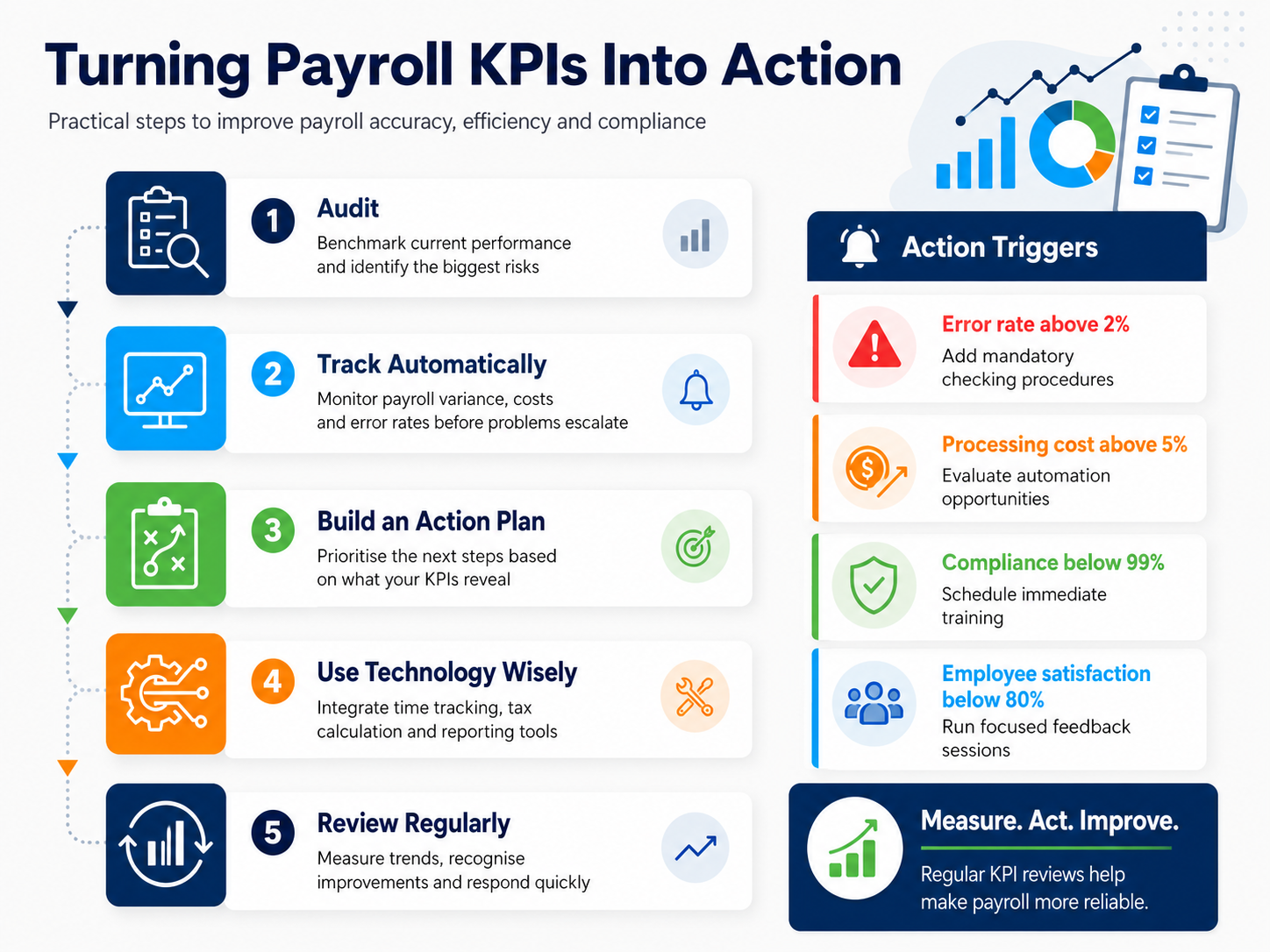
▶Start with a Payroll KPI Audit
- Assess your current performance against relevant industry benchmarks
- Calculate your error rates, processing times and costs
- Use this baseline to identify the two most critical areas for improvement
▶Implement Automated Tracking
- Do not wait for problems to surface
- Set up automated monitoring for key metrics, particularly payroll variance and error rates
- Use payroll alerts to identify discrepancies before they become costly mistakes
▶Build Your Action Plan
Use the results of your audit to determine the next steps:
- For error rates above 2%, introduce mandatory checking procedures
- If processing costs exceed 5% of payroll, evaluate automation opportunities
- When compliance rates fall below 99%, schedule immediate team training
- If employee satisfaction falls below 80%, conduct focused feedback sessions
▶Use Technology Wisely
- Integrate time tracking with payroll processing
- Implement automated tax calculation systems
- Use real-time compliance monitoring tools
- Set up automated reporting dashboards
▶Maintain Momentum Through Regular Reviews
- Analyse trends in your metrics
- Adjust processes based on performance data
- Recognise improvements
- Address new challenges promptly
Key takeaway: Regularly measuring payroll accuracy, efficiency and compliance gives your business the information needed to identify risks, improve processes and make payroll more reliable.